BC Becky

Never Thought I'd Want to be a Breast Cancer Survivor

Category: Emotional Journey

  • More time together

    More time together

    I recall someone mentioning that one of the things they enjoyed during treatment was all the extra time they spent with their spouse. This is something that had not really occurred to me.

    My hubby and I spent every waking moment (pretty much) together for 16-months while on our bike trip. Then we spent 1 year living on opposite sides of the country when he moved to SF and I stayed in Ottawa to work on my PhD. So, we’ve see-sawed on this. We’ve spent a lot of time together and we’ve spend not enough time together. One of the reasons I chose to moved to SF when I did (rather than stick around longer in Ottawa) was that I didn’t like living apart. I remember telling myself that we would not intentionally do that again.

    When I was diagnosed, it caused a re-set on many things. It also caused us to spend more time together – and not just more time in the infusion chair – we really spent more time with each other. Looking back over my blog posts (part of my research), I notice that I mention conversations we had while walking together in the early morning (chemo mucks with sleep patterns). It also brought me back to when we were first dating. We would often go on long walks and chat about this or that.

    Reading about the walks made me realize that I’m missing them. With re-emergence life is starting to get busy again. We are starting to fall into old patterns. Not that we were not happy before, just that there was a new level of intimacy and connection that happened when we spent that intense time together. I didn’t realize I was missing it until I read about it on my blog. And so, with that, we shall try harder to make sure we have time in our week to walk – time to chat about anything and nothing all at once. We know that self-care is important, but couple-care is import too.

    Feature image (c) Rebecca J. Hogue

  • I almost didn’t go …

    I almost didn’t go …

    My proposal for a paper presentation at the Health Humanities Consortium Conference in Houston in March was accepted. When I was first accepted I was really excited about it. Then the plane tickets cost a little more than I’d like. I found myself doubting – do I really want to go? I found myself justifying all the reasons why I might not go.

    It was the celiac talking. It was me trying to avoid going out because the food might make me sick. I was deciding not to go because of fear – not for any really good reason.

    Yes, I’m nervous about the travel – air travel makes me anxious. I used to love it, now I worry that I’ll starve, and end up packing so much food that all I do is eat my way through the flight.

    I worry that I’ll be hungry during the conference. I even asked the conference organizer about food – which they haven’t planned yet. I got an awesome reply. They said they’d try – I cannot really ask for more.

    Once I realized the reason my waffling was fear talking, I decided to push through. I booked my flights, hotel, and registered for the conference. I’m committed now.

    I haven’t been sick since July. That is six months without accidentally consuming gluten. My blood anti-body levels are back to normal. From a celiac perspective, I am healthy.

    I have also tried to get past my fears on a local level. The other day I went out for fish tacos at my favourite local taco place. I only had one thing – fish tacos. I figured that if I tried anything else and got sick I wouldn’t know what made me sick. Next time I’ll try the carnitas (pulled pork) tacos. If I get sick then I know I need to stick to fish. I find that I need to take this one step at a time.

    I’ve also learned that if I’m going to branch out and try something – I might as well try a lot of it and really enjoy it. You see – if something is going to make me sick it doesn’t matter how much I eat. The level of sickness I experience is no different between a quarter teaspoon of flour and two cups of flour, so if something is going to make me sick I might as well get the most of it and really enjoy it – as it will likely be the last time I try it.

    Of course, now that I’ve decided to go the conference, I need to figure out my presentation. I’m working on my research now. I won’t get a huge amount of time to talk – so my presentation will need to be short and focused. I realize now that my past presentations have been a bit scattered – they have included snippets that were not relevant to the message – they may have been relevant to me personally, but they were not relevant to the overall storyline or the message I was trying to send. So now, I’m trying to figure out – what will be the theme for my short presentation?

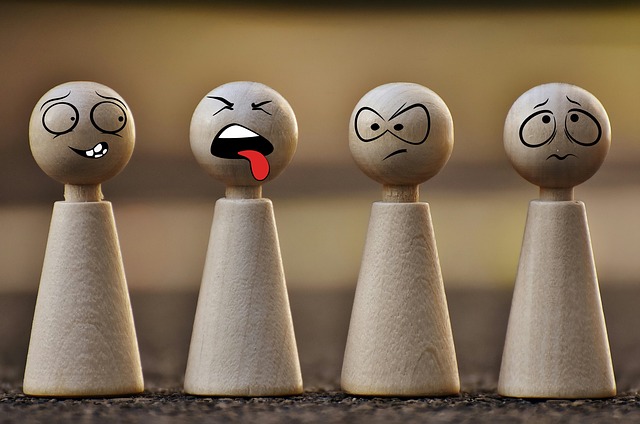
    Feature image CC0 via Pexels.

  • Fear – the neighbour that just won’t go away

    Fear – the neighbour that just won’t go away

    I’ve been thinking in metaphors lately – perhaps because I’m reading some autoethnographies that seem to describe experiences using metaphors.

    As I read through and tag / analyze blog posts from August 2014 – during my last round of AC chemo – I’m struck by how few of them talk about fear. I remember trying to be brutally honest in my posts, and yet, I don’t seem to hear (feel) the fear when I read them. Then I think, perhaps that is because fear – my neighbour – was on vacation for a bit.

    When I was first diagnosed, fear had definitely moved in with me. Fear was the neighbour that just wouldn’t go away – waking you in the night with loud thoughts – and interrupting your concentration.

    In August, three months after diagnosis, but in very active treatment – fear went on vacation. It didn’t go away completely. It called now and again to get an update on how things were going.

    After active treatment, fear moved back in. Getting closer and closer until it was almost debilitating. Fear was the neighbour who moved in to my house but also decided to share my bedroom. It just wouldn’t go away.

    Then, with some coaching (and serious cognitive behaviour therapy), I learned to kick the neighbour out. Now, fear didn’t move very far away. As annoying as fear was, it was still helpful at time. Fear, my neighbour, highlighted when I was overtired or when I really did need to follow up with my doctor. Fear served a purpose.

    Fear was next door, but over time, fear moved a few more doors down. However, fear didn’t fully move away. Every now and again, fear crosses my path – going out to the car, getting the mail (or with every new ache or pain). Fear waves it hand and smiles, and as a Canadian, I do the polite thing and smile and wave back, as if fear wasn’t the neighbour from hell.

    I can be brave, I can stand up to this neighbour, but there is little hope that it will move away completely.

    Feature image CC0 (public domain via Maxpixel).

  • Emotional memory

    Emotional memory

    I’m finding it a little weird that lately I’ve been having memories – almost flashbacks but not as vivid – of the time around my diagnosis. We aren’t at an anniversary of it … that is still 5 months away. It is why I’m finding it all rather strange. And the memories aren’t terribly vivid from a visual perspective, but they are much more from an emotional perspective – except that I feel like I’m looking in on myself.

    I also have a sense that the last few years didn’t happen. This is a sense that happens rather frequently. Maybe it is a part of moving on with my life, and the stepping back into some things? Even as I write this I’m remembering the sense of denial I had … and I’m glad that I don’t remember the feelings of intense sadness … not that I don’t remember that they happened, more that I don’t remember exactly how they felt. I don’t have the emotional memory of those feelings, where I’m having the emotional memory of specific times.

    Now, my research does involve me going back over my blog posts – but for the most part I haven’t done that yet – and really it doesn’t seem to at all be related to that.

    When it first started happening I dismissed it. Now I’m finding that I’m noticing it happening – a perhaps a little more frequently then I’d like.

    Feature image by Joe Shlabotnik via Flickr CC By 2.0.

  • 2016 – A Year in Selfies

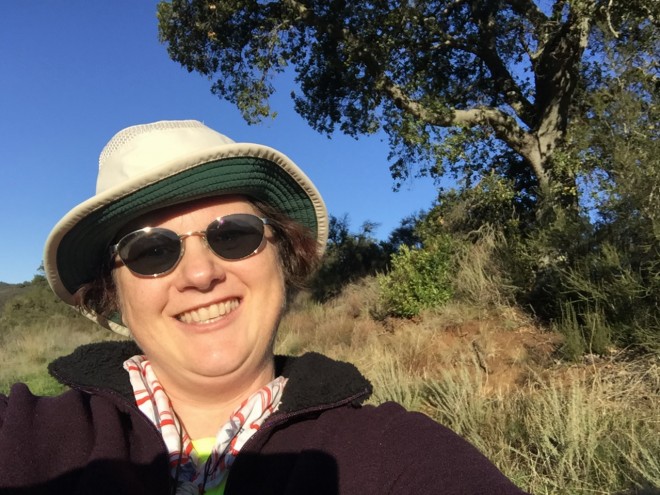
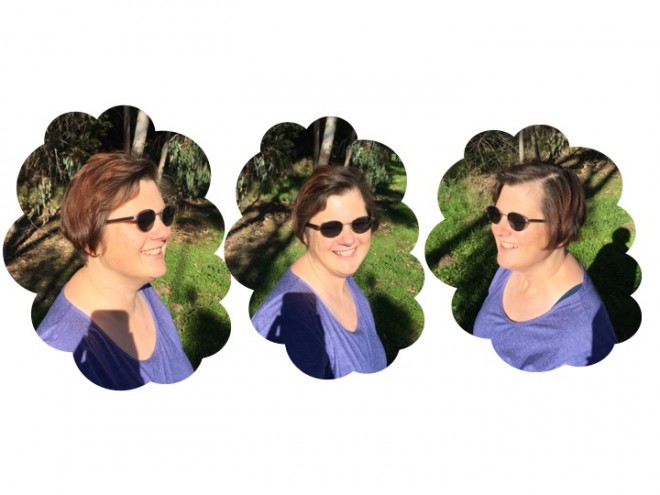
    I love to take selfies when I hike. I’d like to share my year in selfies … some of you might recognize yourself in the pictures 🙂

  • Yesterday I climbed a mountain

    Yesterday I climbed a mountain

    Don’t look down, I keep telling myself as I step across the rock strewn path. I look down and see a clear path, 500 feet (ok maybe only 200 but it might as well have been 500 for how I felt), down a rock strew wash and think it would make for a nice waterfall when it rains.

    I look at where I am and where I need to go. I try to guess where the best path will be. How do I get across this patch of loose rocks? I see a mesquite bush along the wash and decide to go above it, telling myself that if I slip it will catch me before I tumble down the rocky slope.

    I take a tentative step, and few small rocks slide from under my foot, but my foot feels like it is in a solid spot. I reach up to a large rock to see if it  is stable, and start a small avalanche of rocks. It is very misleading, as the large rocks seem to be loose and not anchored, where the small rocks seem to provide better footing. I need to stay aware of this, as instinctively I want to grab onto the large rocks to find a solid handhold. I see another, larger rounded rock the size of a beach ball, and test it out for stability. Unlike the sharp layered rocks that make up the mountain and crumble when you grab them, the rounded rock has clearly been here for a while – with the weather having created its smooth edges. The rock is solid, so I grab onto it with my hands, and tentatively make my next step across the wash, using my arms to reduce the weight I place on my feet, at least until I know that my feet are on solid footing. Slowly, one step at a time, I make my way across the wash and closer to the path down the mountain.

    Yesterday I climbed a mountain. OK, maybe it was more like a hill than a mountain, but figuratively it was definitely a mountain – it was steep and rocky and required a fair bit of technical hiking. Climbing up wasn’t so much a problem, although even at 3700 feet I find that the altitude does affect how quickly I run out of breath. I reflect on how it is always easier to climb up a steep path than it is to climb down one.

    In reflecting back on 2016, I felt that at this time last year I was in better shape than I am today. In January, I went to Epic Experience. I cross country skied for the first time since cancer/chemotherapy. I was feeling strong. And then I injured myself and ended up in a day-cast and crutches for 8-weeks. It seemed that 2016 was mostly a downhill progression in my fitness level. I don’t feel nearly as strong as I remember feeling at this time last year.

    But, as my husband highlighted to me, yesterday I climbed a mountain. That would not have been possible last year. Not that I wasn’t strong enough last year, but that my neuropathy was still really bad. I couldn’t manage a technical hike because after 20 minutes I could no longer feel my feet. I needed hiking poles in order to add a balance point and better know where my feet were. I also had mild lymphedema in my left arm, so I needed to wear a compression garment and had to limit the amount of strain my arms could take.

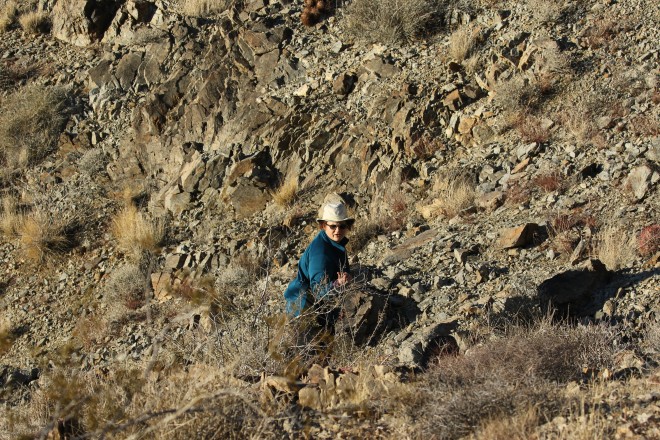
    This vacation I actually climbed two mountains. The first was much less extreme and yet still a major accomplishment for me. It was more a climb to one of the lower peaks of the hills just west of Quartzsite Arizona. Yesterday’s hike was to a lower summit of one of the rocky hills that surround our campsite. My husband continued along to the upper peak while I took rest break and mentally prepared for the trip back down. (Yes that’s me in the photo sitting waiting for my husband).

    The Sawtooth Canyon campsite (California not Arizona) is popular among rock climbers, and we passed a group who where learning how to climb and then rappel. The boulders they were climbing were around more than 50 tall. It was impressive to watch, but also reminded us that when we were looking for a path down the mountain, we had to be aware that there are cliffs. Any give path can lead to a cliff rather than a nice transition down the mountain.

    It wasn’t Everest or anything that spectacular, but it did give me the courage to do more technical hikes. That sounds like a great way to start 2017!

  • December 17 – Just another day

    December 17 – Just another day

    Today was a typical Saturday. At 6am my alarm goes off. I roll out of bed and make myself a cup of coffee. I look at the thermometer and notices that it is 14 degrees inside the house (brrr) and only 1 degree outside – cold enough to cover vegetation with a layer of frost. Shortly before 7am, we hop in the car so I can drop my husband off for his carpool into the city.

    The colder day means that I can find parking at one of my favorite hiking spots – Rancho San Antonio. I am always amazed at how often I cannot get a parking spot at 7am. I climb out of the car and grab my hiking poles. I find myself wishing I had remembered to bring gloves. With the cold, I tuck my poles under my arm and pull down the sleeves of my jacket to cover my freezing cold fingers. I walk. I decide to explore a different route, turning right instead of left. The trail look more like a road than a path. I find it switching back and forth while each step brings me higher on the hillside. After 30 minutes, being unsure whether or not this path takes me back to the parking lot, I ask the first runner that passes me whether or not this trail loops back. He informs me that no, it does not. I am not where I thought I was. I’ve already walked more than 6 km so decide it is time to turn around. I will have to save climbing to the end of the road for another day. When I get back to the car I stop my activity tracker. I hiked 10km (about 6 miles) in 2.5 hours. At about this time last year, this was a typical Saturday morning hike.

    After the hike, I make my way to the Sunnyvale Farmer’s market. The market doesn’t open until 9am, so the morning hike means that I can stop by the market on my way home. Walking through the market, collecting fruit and vegetables for the week, I enjoy sampling the many different fruits that are currently in season. This takes a bite off of my post hike hunger. I discovered that there are still some good organic persimmons. I had thought the season was over, so I am pleased and grab 10 or so. The total comes to $5, so I find myself wishing I had grabbed more. I also discover that several of the stalls still have tomatoes. It has been three years since moving to California and I still don’t understand the seasons here!

    Once I’m stocked up with fresh produce, I head home for a quick shower and some lunch. Since it is the third Saturday of the month, I have a support group meeting at Bay Area Cancer Connections. I’m so thankful that this place exists. I think of how hesitant I was the first time I attended. My husband pretty much forced me to go. I was still having trouble even saying that I had breast cancer.

    After group, I head home for a brief time and try to get some work done. An hour later my phone beeps with a text telling me that my husband will be ready for pickup in 30 minutes. I have just enough time to finish what I was doing before hopping in the car. When we get home, I throw together some dinner influenced by left overs from last night.

    A pretty typical Saturday. What makes this particular Saturday different is that it is December 17. Last year on December 17 I felt sad. I was a little surprised by that feeling. This year, I don’t seem to have any special emotions. I am not sad, nor am I happy. I’m having a pretty typical, not particularly interesting day.

    What’s so special about December 17? On December 17, 2014 I had a nipple sparing double-mastectomy with immediate DIEP flap reconstruction – a 10+ hour surgery. The double-mastectomy removed the last of the known breast cancer from my body. Because I did immediate reconstruction, it also represented the last big hurdle in my treatment and a transition from active treatment to active recovery. December 17 represents my cancer-free day. I’ve been cancer free (or at least free of any known cancer, one never really knows) for 2 years. Let’s hope that I have many more uneventful December 17ths in my future!

  • New hair day

    New hair day

    I’m a little obsessed with my hair. Not in a need to be a fashionista kinda of way, just in a way in which my hair fell out, and the way in which it is recovering from the effects of chemotherapy.

    Yesterday I got my first hair style in years (too many really). Even before cancer, I had pretty consistent hair style for about 3 years, and then with cancer I lost all my hair. So, it is a bit of a milestone to get a new haircut that wasn’t about trimming off the post-chemo frizz.

    I have to say I’m really happy with the way it turned out. The stylist actually listened to me when I told him “I’m a wash and wear kind of gal”. I don’t even own a blow dryer or hair iron of any sort. So to have something that looks decent and doesn’t require a lot of maintenance is awesome.

    I’m also not someone who typically wears make up. I never have been. But I noticed in all the video conferencing that I do that I don’t like how my face looks. I realized that something was not quite right. My eyebrows didn’t really recover from the chemo loss. I have eyebrows but not thick ones. This means that when I sweat, it drips into my eyes – which is exceedingly frustrating, but I also realized that in head shots, not having eyebrows makes my face look round and chubby. It took me quite a while to realize it was the lack of eyebrows that made me feel like I didn’t look right. And so, with that realization, I bought an eyebrow pencil/brush thing. I’ve started to fill in my eyebrows when I know I’m going to be online or going out to visit people (although not for hiking, as then I’d just get eyebrow make up in my eyes!

    I find this new obsession with hair to be interesting. It isn’t just hair on my head, rather hair all over my body. When my arm hairs grew back they came up in every which direction. My original arm hair grew all one way. It felt tamed. Although no one other than me sees my arm hair (unless I show them), it still is something that is different. In some ways it is fascinating, in others it is just odd.

  • Survivorship plans

    Survivorship plans

    There is a theory that at some point after active treatment you have an appointment to review a survivorship plan. That is, what do you need to know and do once active treatment is over? How do you manage your health issues post treatment?

    I went to that appointment, but didn’t get much out of it. In part, I pushed for the appointment too early. I think now, at two years, I’m finally ready to start thinking about survivorship. I am not so much in “active recovery”, as I am in trying to figure out how to be a healthy person again.

    One of the challenges I’m navigating now is that I get healthcare from two different organizations (Stanford and PAMF). My medical records are consolidated through Care Everywhere – this means that my medications lists are cross posted and any blood tests and such also get cross posted, but detailed notes of procedures are more challenging. I often need to tell the doctors about my recent medical history.

    I’m struggling with when I should be seeing primary care and when I should be seeing specialists. I have a bunch of specialists – both at Stanford and at PAMF. Some of them were temporary specialists, in that I only saw them once or twice and there is no plan for continuing care from them; however, they may have prescribed something, so I am coming up with needing renewals of prescriptions and have no clue which doctor I should be talking to. Fortunately, many of things my primary care doc is happy to take over management. So, I’m starting to consolidate, and I’m starting to reduce the number of specialists I’m seeing. I am also choosing to trust that my primary care doc will send me to the specialists when things are out of scope for her.

    Through all of this, I’ve learned to pass on the specialists I don’t like, and keep the ones I do. I’m still scared that I’ll miss something – that this symptom or that will mean more than it does – but I’m trying to find that trust in my body again. I’m trying to figure out how I can be ‘healthy’ again.

    I also want to highlight that because of my surgical choice, and the fact that I don’t have hereditary cancer, my follow up appointments with oncology don’t generally involve additional scans. If I don’t have symptoms, then I don’t have scans. All of the scans I’ve had post-treatment have been brought on by symptoms, and all have come out negative for cancer – but they took a toll on me mentally. Each time, I had to deal with fear. I’m getting better at not completely overreacting, but I’m still finding myself overly stressed until I can get the scan over with. I look back and think that I put myself through horrible scans (the latest being a colonoscopy), and they turned up negative. I am really just sick of scans and tests. I need to step back and work towards a reduction of medical appointments. I remember pledging to try to schedule embargos on doctors appointments, and yet I have failed to follow through with that. I do manage to avoid appointments over my two week holidays, but I haven’t managed to successfully book an appointment embargo for a time when I am in town. I need to get them back into my calendar, and I need to learn to stick to it!

    Feature image CC0 via Pixabay

  • Health (illness) bloggers

    Health (illness) bloggers

    In my literature review for my research I came across a great article (Keating & Rains, 2015) on the social support health (illness) bloggers receive. The article does a good job looking at social support of bloggers over a three year period.

    One of the things that came clear in the article is the use of the term health blog rather than the term illness blog. It has really got me thinking. A lot of bloggers shy away from the term illness blog because of the negative connotation around it. My immediate thought was the opposite of illness blog is wellness blog, but the term wellness blog is already used for those who are promoting wellness (e.g. diets, exercise routines, etc). Although the health (illness) blogs are written by someone who is experiencing illness, the focus of the blog is often the personal journey – and that journey is someone trying to figure out what health looks like for themselves. I do like the more positive connotation that health blog implies.

    I pulled out the following findings from the article:

    “The results indicated that changes in support available from blog readers and from family and friends over the course of 3 years were significant predictors of changes in bloggers’ well-being. Increased support availability from bloggers’ family and friends was associated with a decrease in bloggers’ feelings of loneliness and an increase in their feelings of health self-efficacy” (Keating & Rains, 2015, p.1454)

    The article makes mention of the idea of strong-ties and weak-ties. Strong-ties would be those with close family and friends. These are the people you can call anytime. They are your primary support. Weak-ties are those of acquaintances. They are not necessarily your close friends, but they still provide support through your experience. In this case, bloggers often have weak-ties with other bloggers. These weak-ties also help in increasing the feeling of support and decrease feelings of loneliness. I think we need both.

    “The results also demonstrate the benefits of blog reader support and suggest that this type of support can serve as a unique resource about and beyond strong ties. After we controlled for changes in support available from family and friends, change in blog reader support was associated with decreased health-related uncertainty. Bloggers who reported an increase in support from blog readers across the two measurement periods also felt that their health condition was less unpredictable” (Keating & Rains, 2015, p. 1454)

    What really resonated with me here is the idea that reading blogs helped to make my experience with breast cancer treatment less unpredictable. I was able to read a lot about people who had experienced the same surgery and breast reconstruction – so I better understood what my experience might be like. You cannot fully predict your experience as each journey is individual, but it really does help to have some general ideas of what you might experience as well as some tips on how to better cope.

    “In addition, the findings suggested that bloggers who perceived themselves as being in better health at the first time point were less likely to continue blogging over an extended period of time. It could be the case that those who evaluated themselves as being in better health were less likely to perceive value in continuing to document their experiences” (Keating & Rains, 2015, p. 1455)

    The idea that we blog less when we are healthy is something that I’ve definitely seen and experienced. We often feel like when things are going right we have nothing to say. A blog post that says “today was normal” does not feel that interesting, and yet, it is an important thing to say. It is really important to celebrate the good days, so that the blog is also providing encouragement to other patients. When cancer bloggers stop blogging we assume one of two things (1) they are healthy and don’t think they have anything interesting to say, or (2) they have died.

    “Through connecting authors with individuals who are coping or have coped with a similar condition, blogs appear to be a particularly useful resource for helping individuals to better understand their illness experiences” (Keating & Rains, 2015, p.1455)

    As a blogger, and one who reads blogs, I completely agree. Reading other blogs did help me better understand my experience. Overall, I did find that this particular study aligned with my experience as someone who both authored and followed breast cancer blogs. Now I just need to get into the habit of using the term health blogger rather than illness blogger.

    Reference

    Keating, D. M., & Rains, S. A. (2015). Health Blogging and Social Support: A 3-Year Panel Study. Journal of Health Communication, 20(12), 1449-1457. doi:10.1080/10810730.2015.1033119


css.php