BC Becky

Never Thought I'd Want to be a Breast Cancer Survivor

Category: Emotional Journey

  • Friends

    I have not written in a while. I’m finding myself struggling to write, in part because my struggle isn’t really my struggle, so much as it is the struggle of a good friend.

    I know few people here. I got diagnosed just after arriving, so social circle revolves around the amazing people I met at cancer support groups. But, unlike a lot of those friends, they have other friends. They have lived here their whole lives, and as a result have so many other friends, that I know are closer than I will ever be. I am a cancer friend.

    Recently my hiking buddy, Lori, is dealing with the next progression in her disease. She has metastatic breast cancer. Metastatic breast cancer is the type of breast cancer that kills. It is terminal. Her life revolves around what the next treatment might be.

    We started hiking together when she was on horrible chemo #1. This was a clinical trial chemo. It did a good job of stopping her cancer from growing, but it also meant that one in every three weeks she was chemo sick. The rhythm was chemo, sucky week, two good weeks, repeat. We hiked during the two good weeks.

    Then that chemo stopped working. She then jumped onto another trial, of a PARP inhibitor. This one didn’t work, so she didn’t last long on that one. Then came xeloda. This one worked for a while, but caused a side effect known as “hand-and-foot syndrome” where her hands and feet went red and felt like they were burning. Her skin changed and she had no fingerprints. Her heals would crack and bleed. She described her skin as being smooth like plastic wrap. This was a pill-based chemo that she took for two weeks then had a week off. During her off week and the first week she could still hike.

    While hubby and I were off on vacation, the xeloda stopped working. She had a really bad progression. It was not just tumors growing, but new tumors showing up on scans in different organs. Not good. She is now hoping to be on an immunotherapy trial starting next week. Hoping. She has not been on any chemo for more than 20 days (required for the wash-out period before joining a clinical trial). I am crossing my fingers and praying that she gets into this trial and that the immunotherapy works for her. If it does (or her next chemo does), then I’ll get my hiking buddy back – but regardless of hiking she has become a close friend and it breaks my heart when I think about losing her, but I know that is inevitable – her disease is terminal.

    That is Lori’s story. My challenge has been that I have few other friends. She has a 40+ years of friends and family that want to spend time with her. I know that I am a good friend, just that she has so many people wanting to see her and very little energy to do it. I’m staying in the background, but offering up my support in any way I can. But, it is already leaving a hole in my world.

    I realize that too much of my social world is either in the cancer sphere or virtual. I love my cancer friends and I love my virtual friends, but I am feeling the emptiness in the non-cancer, non-virtual sphere. It leads to loneliness, which in turn leads to depression. I know this is happening. When you add this to the weight of knowing your closest local friend is going to die, and it might be soon.

    I’m struggling. I’m working on my dissertation. I’m teaching. When hubby first moved here (he moved a year before me), I started reaching out to others. I started to make friends. I was doing the emotional labor that is required to help make new friends. But then a cancer diagnosis changed that. I couldn’t go out and make new friends outside of the cancer sphere when I was in active treatment.

    I’m two years out of active treatment now, and I am realizing that I need to start putting in the emotional labor of making new friends. I need to figure out what I’m doing professionally, and connecting to others that do what I do. I will try to get involved in meet-ups, so that I meet new people. Working from home makes this an extra challenge. Working on my dissertation also means that I don’t have a lot of extra time. I’m pushing to get it done, but the cost is that is that I don’t have the time or energy to seek out new connections which might lead to new friendships. But if I want to fight off depression, I know that I need to do this. Depression also slows down the dissertation process, so it does not serve me well. And so, as a first step, we are going back to church. My only non-cancer friends down here are Unitarian friends, who have started to engage with the Palo Alto Unitarian church. I’ve not been there. We will give it a try and hopefully find a new spiritual home. I think that is what I need right now more than anything, and that will help me when I have to deal with the intense grief that I know one day I will need to deal with.

    If you’ve moved to a new place, what have you done to make new local friends? 

  • Normalization of ‘young’

    I have said before that with all the talk about surgery in the breast cancer community, the idea gets normalized. That is, if you are part of support groups, you talk about various aspects of surgery a lot. Surgery is the primary treatment for breast cancer. It is the treatment that all early stage patients experience. There is still a lot of fear around surgery, but a lot of the aspects become normalized.

    What I realized was that I also seem have normalized the idea of young. Breast cancer is predominantly a disease of post-menopausal women. It is rare to get breast cancer before you are 50, and yet it happens. Because of this, I am part of a couple young survivor groups, where those diagnosed under 45 (or 50) talk about issues that are slightly different to older women. Some of the women in my support group have young children, others are of childbearing age and having to make difficult decisions about having a baby or staying on anti-hormone therapy. Then there are the economic issues and employment issues.

    But back to my point. When people look at me and see the ‘cancer sucks’ stickers on my laptop, they don’t connect me with breast cancer. I remember during my first infusion, sitting in the chair in the ITA (infusion treatment area) and the gentleman sitting across from me said I was too young to be there.

    It is also a weird age to have cancer. You are not a childhood cancer survivor, and yet you are too young to have cancer. It is odd.

    But since most of my community in the breast cancer world are young survivors, it means I get a sense that being a young survivor is normal. It means that when I see and hear about other breast cancer survivors, I assume they are young. In my mind, the picture of a ‘typical’ survivor is someone my age – and that isn’t true. My experiences in many ways is atypical.

    It is an interesting observation.

  • I’m not brave – another cancer war metaphor

    With John McCain’s diagnosis with brain cancer, we are seeing discussion about cancer and the war metaphor in the media. My social media streams are full of articles like this one Obama’s tweet to John McCain about his diagnosis was the last thing cancer survivors wanted to see. The author makes an important point about how some of this encouragement is more for the benefit of the speaker than the recipient. It is the voice of someone with healthy privilege trying to find something to say that will help the healthy person feel better about the illness.

    I found at one time during my treatment that the war metaphor helped me. It was not someone else telling me to fight, rather it was an internal fight – a mindset that helped me get out of bed in the morning and go for a walk. At the time I decided I was a warrior. I was in active treatment. It was a metaphor that I chose to use because at that time it worked for me. The metaphor worked for a short period of time during my treatment. But then it stopped working. I was no longer a strong warrior, rather I was weak and fatigued and just wanted the treatment to be finished.

    The one metaphor that never really worked for me was that of bravery, which is also a variant on the war metaphor.  I’ve been told many times that the sharing I do in my blog is an act of bravery. That I was brave to be sharing my experience so openly, but also that my experience in and of itself was an act of bravery. Facing cancer and cancer treatment was in some way an act of bravery. Like I had a choice in it. Personally, I’d rather not be brave if it meant I didn’t have to go through the cancer experience.

    The reality is that I don’t in any way feel brave. I never have. I even wrote about having my inner two year old having a temper tantrum because I didn’t want to do another chemo treatment. That wasn’t brave. It was real. 

    Cancer is not only an attack on the physical body, it is also an attack on the mental one. The focus on metaphors at times helps the ill person to cope, but at other times it doesn’t help. There are times when it changes the focus from what the ill person needs (someone to listen to them, and to acknowledge the experience as it is really is), to something the healthy person needs in order to feel better about the ill person.

    I have learned through this experience. I might have used the war metaphor before I was diagnosed. If I did, I apologize. I really didn’t understand.

    I have learned to acknowledge the illness and the feelings the ill person is experience (I need to put in a plug for Kelsey Crow’s book There is no good card for this – as it is really a great way for people to learn how to help). My response to someone telling me that their cancer has spread is usually “well that sucks”. I try very hard to just listen and acknowledge the feelings the person is having. Sure, I slip into trying to be a “fixer” at times, but I also try to be aware when I do it. Acknowledgement that it sucks is often all the person needs – well that and some good bone broth, soup, food, or someone to clean their house.

  • I’ve stopped sharing my crisis

    Yet again I went through another scare. It happens much less often now. I’d say about twice a year. Something happens. I feel a pain or a lump or a bump – and my mind spins out of control. I get overwhelmed with fear.

    It started a couple of weeks ago when my family doc found a swollen lymph node in my neck. This is actually quite common when you have any kind of infection. It is your body doing its job. I couldn’t feel it. I wasn’t sure what she was feeling. She tried to show me, but what I thought I felt isn’t a swollen lymph node – but it led me down that path. She was so sweet when she said, “if it is still there in 1-2 months I’ll order an ultrasound, and if it shows something I’ll refer you to an ENT for a biopsy”. Then she whispered “to rule out cancer”. It was so sweet because she didn’t just blurt it out like some doctors do. And she didn’t call is “C-A” instead of using the word. I confirmed that it was most likely a normal infection kind of swollen and nothing to really worry about.

    I also had a new set of back MRIs. I’m seeing the spine specialist at UCSF on August 1st, and I wanted to make sure I had the latest information.

    When I picked up the CD (I always order the CDs so I have a copy, but also needed to get a copy for UCSF), and got home, I had an all out panic attack. Chest pain, trouble breathing … I was able to sit down and calm myself down. Then I looked at the CD and the report was not on it. That annoyed me. I could see what the radiologist was pointing out, but I couldn’t tell why. I could compare it to my last MRI (almost a year ago), but without the interpretation I couldn’t tell. That freaked me out. I emailed my family doc (the one who ordered the MRI), but had to wait through the weekend for the reply. She sent along the results. The things that I was freaked out about are nothing. It is an incidental finding and it confirmed that there has been no change since the last MRI (many people have some cyst or something in various places in the spine – they are totally benign and normal). The new incidental finding is a cyst behind my kidney – I get an ultrasound of that next week. Again, this is another one of those “normal” things, that is an incidental finding from the MRI. It wasn’t there last year, but is there now, so they will look at it with the ultrasound.

    But then there was this lymph node in my neck. And then I though I felt something in my under arm. And a couple days later, I thought I felt something in my underarm again. I freaked out. I did not sleep well. I emailed my oncologist and he ordered an ultrasound and biopsy if necessary. That biopsy bit freaked me out. Fortunately, I was able to get in to see my oncologist’s nurse practitioner yesterday, and he did an exam and confirmed that there was nothing there. He felt nothing at odds during the exam. I pointed out the neck lymph node – he said if he tried hard he could feel it, but it wasn’t anything that popped out as worrisome. He ordered an ultrasound of it mostly because I was crying and it freaked me out.

    The crying was mostly a release. It was the letting go of all the fear that had built up over the last couple of weeks.

    Now, I’m annoyed at myself for this whole episode. I want that whole cycle to stop happening. Fortunately it isn’t that often anymore – maybe twice a year. I try very hard to convince myself that it is nothing, but it doesn’t always work. I’m a little afraid of what this will mean when I move back to Canada – will I have the easy access to my oncologist for that immediate confirmation that there is nothing to worry about? I cannot work when I’m that state of fear. I cannot focus. I have trouble sleeping. It becomes this horrible vicious cycle – the fear feeding on the lack of sleep, and the sleep not coming because of the fear.

    Back to the point of this rambling blog post – I don’t share my crisis anymore – or at least I don’t share them while they are happening. I wait until they are resolved. Then I write the post. This is in part because I don’t want my loved ones to be afraid. I don’t want them to experience that fear that I have. I need them not to – because I need those around me to be ‘normal’. To not share the fear, but also not dismiss it, or not try to convince me that everything will be fine. I need to convince myself that everything will be fine. Hearing it from most others doesn’t necessarily help. Hearing it from the right other (usually an oncologist or nurse practitioner in oncology) does help.

    Everything will be fine. It is what it is and that is OK. Now on to my regularly scheduled programming …

  • The complexities / interplays of trust

    One of the “themes” that has emerged in my dissertation study is that of “learning about the disease”. When I look at the types of information I shared on my blog between diagnosis (June 12) and active recovery (Feb 3) is that of learning about the disease. I’m looking at the different ways in which I found myself learning about, and sharing knowledge about breast cancer. There isn’t a simple path – first you learn from A, then B, then C – it is a whole lot more complicated than that.

    I have commented several times that a friend very early on in the journey has recommended that I should “decide who I trust, and trust them”. I use that mantra quite regularly when I am second guessing what I think might be happening.

    Add to it the complexity and lack of clarity – you see, cancer treatment, and more specifically breast cancer treatment, isn’t clear cut. Yes, there are certain protocols that are followed in certain circumstances, but there is a whole lot of complexity – and that complexity means that there is never one and only answer. As we like to say in the design world, there isn’t one ‘right’ solution, it is just that some solutions are better than others.

    Now, if we look at all the different places I found information:

    • My body
    • Google (open searches)
    • Doctors (primary care, radiologist, breast surgeon, oncologist, plastic surgeon … )
    • Nurses of variety of sorts
    • Test results (pathology, MRI, ultrasound, blood tests)
    • Organizational websites (e.g. breastcancer.org)
    • Blogs
    • Face-to-face support groups
    • Online support groups
    • Friends
    • Family

    The list goes on. In some cases these different information (and advice) sources overlap. In others they don’t. I had to learn how to discern not only where I could get information, but also what types of information I could get from where, and how reliable that information was. There were so many nuances to information that I didn’t always appreciate at the time, and some that I still don’t appreciate.

    Three years later, although I have a much better sense of information and where to find certain types of information – I’m still finding the ground constantly changing. I think I know something, then something happens that causes me to question what I’m thinking. I doubt. I freak out. I go into high gear trying to get answers. I trust someone / something. I relax, but only until the next time it happens. I only hope that there will be longer gaps between issues.

    I have those of my healthcare team that I trust. I also hear stories, horror stories, from others that have me questioning – not my care team directly, but some of the facilities around my care team. Can I trust that pathology report? Can I trust the radiologist? Hearing the experience of others sometimes makes it more difficult to trust. I hear how others put blind trust in the system, and that trust failed them. I find myself being thankful for not having been so blinding in my trust. But then I also find myself stressed over things that I should not be. I find myself questioning things I need not question. The danger of being a well informed patient in part comes when the doctors forget to tell you things assuming you already know. Or when you think you know things so you don’t ask. Or when you doubt what you are being told. Blind trust can be dangerous; however, intentional trust can be liberating…the goal is to distinguish between the two.

  • Celebration or not …

    Celebration or not …

    Yesterday marked three years since the radiologist said the words “I’m sorry, you have breast cancer”. It is hard to believe that was three years ago.

    I had a doctors appointment yesterday. At one point I broke down in tears, completely unrelated to the appointment. The doctor asked me what was up. I explained that it was the day – three years since diagnosis –  not anything about the appointment. She told me that I should celebrate. That I should find some way, even if it is just a small way (like throwing a rock into a stream). She talked about the importance of acknowledging being alive.

    I am struck by this. I don’t know what to think about it but the words keep running through my head.

    I did do one thing yesterday that was a bit of a marker of the day. Since I was already up at Stanford, I walked over to my tree – the tree where I took my picture before every infusion and doctors appointment throughout treatment. It has been months since I last saw the tree (might even be a year). I don’t see my doctors up at the main campus that often – mostly I see them at South Bay which is about the same distance but so much easier because I don’t need to spend 15 minutes walking from the parking garage to the clinic – and the parking is free. I’m also having fewer doctors appointments. I’m reducing the frequency of my visits. That too is forward moving progress.

    I took this picture – perhaps that is my celebration – or perhaps this blog post is:

    2017-06-12-13-16-24

    I have hair now. I get lots of comments from my doctors on its length. It is much longer than it was before cancer. What you don’t see is that I don’t really have eyebrows. They didn’t really grow back – at least not enough to be functional (they don’t keep the sweat out of my eyes), and not enough to frame my face when I’m not wearing glasses. Anyways, that is a minor annoyance. I am learning to live with, and be happy with, my new body.

    And the words “you should celebrate being alive” keep ringing through my head. I cannot help but wonder if that celebration is more for the doctor – their achievements in keeping me alive – then it is a celebration for me. I tried to explain that no, today is not the day that I celebrate. But I couldn’t get it out to really explain. The ‘celebration’ or ritual is much more around December 17 – the day the last bits of known breast cancer were removed from my body. That day is significantly more important than the day that I heard the words that haunt me “I’m sorry, you have breast cancer”.

    Do you ‘celebrate’ or acknowledge that day you were diagnosed? What is your ritual?

  • Carlos whoever you are, you are an ass!

    Carlos whoever you are, you are an ass!

    This afternoon, after travels (hers then mine), progression (hers), stupid chemo side effects (hers), and colds (mine), Lori and I finally managed to get our schedules lined up for a hike. We hike for a variety of reasons. We both enjoy it. Hiking helps Lori feel better when she is having a crappy day (or week or month), and helps replenish her energy when it is running low. It is especially important this week, as she prepares for radiation treatment for a tumor in her spine (which will hopefully mean she is in less pain, and up for more wonderful hikes).

    It has been a while, since we last hiked. Lori’s latest progression means she is taking a higher dose of the chemotherapy she is on. One of the side effects is that it makes the skin on her hands and feet really thin (she no longer has fingerprints, and informs me that one reason we have prints in the skin on our feet is so that we don’t slip on wet surfaces – one of those things you don’t realize until you no longer have the prints). The thin skin on her feet has led to cracking and bleeding. This has made it difficult for her to walk without pain – that and a particular “hot” tumor in her spine. With this in mind, we opted for the easier hike. One that involves parking in the lower free parking lot, and follows the creek on a well established trail. This trail also has lots of benches, strategically placed, which made it the ideal hike for me when I was recovering from breast cancer surgery and chemotherapy. The lower parking lot is almost always full, however there are a couple of handicap spots which are often open. I used to park there all the time when I had a permit. Being able to park there meant that I could walk/hike. Otherwise, I would not have been able to do it. I no longer have a permit, but Lori has one. It means that we can hike places that otherwise we could not – for lack of a parking spot.

    I like hiking with Lori because I enjoy her company. We both seem to hike at about the same pace. We spend the entire time chatting away, and often don’t notice how far we hiked. Today was one of those days. We ended up hiking 5 miles (8.5 km) and forgot to take a selfie at the top of the trail – so we took one at the bottom.

    2017-06-11-16-34-03

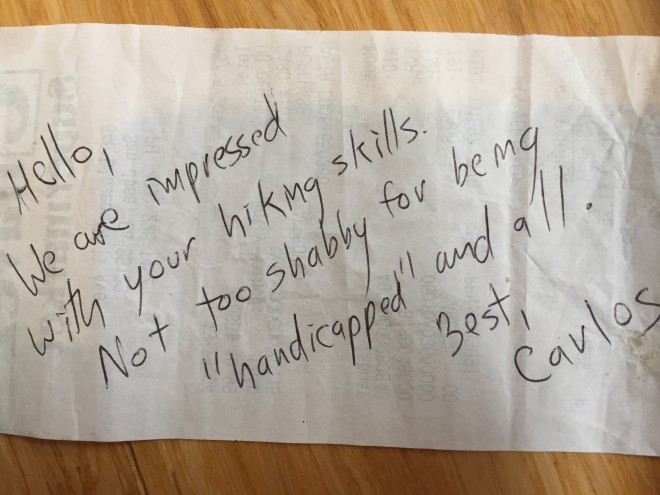
    As we were driving out of the parking lot, we noticed that someone (Carlos the Ass) left a message, tucked in on the wiper of Lori’s car. We can only guess that it was written as we were heading out for our hike, as it is the only time people would associate us with the car. Anyways, Carlos the Ass writes “Hello, We are impressed with your hiking skills. Not too shabby for being ‘handicapped’ and all. Best Carlos [the Ass]”.

    2017-06-11-18-49-40

    Lori gets this a lot. She doesn’t always “look” sick. At our other favorite hiking place, we have gotten dirty looks, and sometimes even snarky comments made under someones breath – intentionally just loud enough for us to hear. Usually when that happens Lori blurts out something that hopefully makes the person feel like sh## for being so insensitive. For example “I’d gladly trade in the terminal cancer for the parking spot”. Fortunately, she no longer cares. She doesn’t take sh## from anyone anymore. Her life is going to be too short to deal with assholes.

    It still annoys me. It annoys me enough that I had to write this post. Disability is not something that is clearly visible. Interestingly, one of our many discussions on our walk was the challenge with how dealing with airports when standing in line is excruciatingly painful – and not in the annoying sense, in the physical sense. There is a lot of ‘but you don’t look sick’. There is a huge misperception of what sickness looks like. People seem to like judging others.

    Anyways, back to my rant about Carlos the Ass. It seems that he felt it necessary to find a pen and a scrap of paper (it was written on the back of a grocery store receipt that he clearly had hanging around his car). It extra pisses me off because it was Lori’s permit – Lori has terminal cancer and no clue if she will be alive in 3-6 months. Every cancer patient I know (terminal or otherwise) would gladly trade in the handicapped permit if it meant they didn’t have to deal with cancer, treatment, and its aftermath.

    So please, don’t be an ass. There are way too many of them in this world already!

  • Not fighting a battle – the closure to the narrative is death itself

    Recently, I read a book chapter by Arthur Frank (2009) titled “The necessity and dangers of illness narratives, especially at the end of life”. It got me thinking.

    One of the pet peeves among many cancer bloggers as well as those with metastatic breast cancer is cancer as a war metaphor – that is, the fighting a battle with cancer language. Many people don’t like suggestion that those who died from breast cancer “lost”, as if they did not try hard enough, as if breast cancer was something that involved winners and losers.

    In the article Frank says that “narrative thinking embeds the idea that obstacles must be overcome for there to be a closure. Moreover, obstacles are necessarily understood as a personal test, conveying a sense of individual victory or defeat.”

    If I look back on my experience, there was a time where I identified as a warrior. The metaphor worked. I was in chemotherapy and suffering from a variety of side effects. I needed to fight to keep exercising and do my best to keep strong. The war metaphor worked for me. It motivated me. In reflection, I see that it worked because I needed the sense of closure. I needed to know that the immediate experience I was having would end. To mentally make it through all the suckiness that was chemotherapy and then surgery recovery, I needed a sense of ending. So the war metaphor gave me a sense that there would be closure to that part of my life’s narrative.

    But now, after acute treatment for early stage breast cancer, I feel that the war metaphor no longer works. It doesn’t work for my friends who are metastatic and will die from this disease. But it also doesn’t work for me. With survivorship, one of the things I am coming to terms with is that there is no sense of closure. There is no clear ending. The war metaphor no longer works for me. I’m living with all the side effects of treatment, and with all the fears of the cancer coming back, or another cancer happening. I do not expect that there will ever be that pretty closure that narratives seek. But I also think that is part of the point.

    It got me thinking about why the war metaphor works for some people. With the war metaphor there is an a sense of ending, a sense of closure. But for most people with breast cancer, the only ending or sense of closure is death. It is not a narrative that is meant to have closure. The need for closure takes away an aspect of the experience that is paramount to those who are surviving after breast cancer treatment. You don’t know that you “survived” breast cancer until you die from something else. And those who do die from breast cancer, don’t lose a battle, they die. The sense of closure in the narrative is death. It doesn’t need to be a battle lost. It shouldn’t be a battle lost.

  • It’s amazing the difference a good night’s sleep makes

    Wednesday night I did not sleep well. I had a hard time getting to sleep and a hard time staying asleep. I woke up early Thursday morning exhausted. To make matters more challenging I also had to be out of the house for most of the morning. I found that I could not concentrate. I struggled with focus. I couldn’t get any work done. I felt miserable. I spent most of the day on the couch watching TV.

    What is worse than not feeling great are the dark thoughts that run through my mind. I find myself questioning whether or not the sickness that I’m feeling is a return of cancer. I find myself going down dark paths in my mind feeling like this disease is going to kill me.

    My logical brain tries to dig me out of the hole. I try to reason with myself, reminding myself that I don’t need to be thinking this way – that worrying and having these thoughts will not change any outcomes – that there is not point in dwelling in this misery because it doesn’t make any difference. I try to convince myself that I’ll be OK – and that I am OK now. I try. But those dark thoughts keep popping in to my head – they overwhelm me.

    Then the day ends and I go to bed. Last night I slept well – a solid 8.5 hours sleep. I woke up well rested. Although the heat wave broke, so the temperatures are a perfect 22 degrees C, sun shining, with a nice cool breeze. Exactly what I needed.

    Today has been hugely productive. I’m almost done marking. I made progress on my dissertation. I’ve done other self-care things that I needed to do. I walked around the block a couple of times. I’m feeling so much better.

    I know that sleep affects my mental health – but this highlights just how much. Today I’m glad that last night I slept well!


  • Remission society and mourning my fantasy future

    Remission society and mourning my fantasy future

    I apologies to those who read all my blogs, as I am cross posting this. I’d love to hear answers from the various readers of my different blogs.

    I want to connect two ideas: the idea of remission society as described by Arthur Frank (1995), and the concept of the fantasy future that I learned while on a cancer care retreat at Commonweal (February 2015).

    Frank (1995) explains that anyone with a chronic illness lives in the remission society. Frank (1995) describes how “in modernist thought people are well or sick. Sickness and wellness shift definitively as to which is foreground and which is background at any given moment. In the remission society the foreground and background of sickness and health constantly shade into each other” (p.9). I interpret this as the way in which I shall never not be a cancer survivor. Breast cancer is a sickness that will always be part of my identity, regardless of how healthy I am at any given moment. It also will always affect my wellness. I will never be well in the same way I was well before cancer. I may be in remission, where I am not sick but nor am I well. I think of remission as this space in-between, or perhaps above or below, not on the same axis as the well or sick dichotomy.

    In order to deal with my emotional wellness, I needed to address the loss of my place in the well category in the well or sick dichotomy. While in active treatment, I was clearly in the sick category; however, once chemotherapy and surgery where done, and the last of the known cancer was removed from my body, I was no longer in the sick category, but also was not in the well category. I was in remission. It was learning of the falseness of this dichotomy that helped me move beyond it. During a group therapy session, the therapist made a reference to the idea of a fantasy future. That is, the concept that all futures are a form of fantasy. We imagine what our future life might entail (e.g. growing old together, remaining in perfect health), but the reality of life is never what we had imagined. A big part of my emotional healing was to forgive my body for the loss of my fantasy future.

    Another part of this reality, and one that I’m still working on, is that it should help me focus more on the present. What is in the now, and the short term future, rather than the long term future. This is, in theory, to help reduce anxiety today, but focusing on today rather than focusing on the uncertainties of tomorrow. However, this of course causes the problem I describe in my paradoxical future. Where I struggle with the challenging balance between planning for the future and seizing the day.

    Perhaps that is in part what it means to be in the remission society (as opposed to being sick)? When I was clearly sick, my focus was on a very short timespan. I saw life on very short horizons – tomorrow, next week, next month – never more than three months. I just couldn’t plan that far in advance. But now, after I have mostly healed from chemotherapy and surgery (I say mostly, because some of the damage will never be healed), I see the potential for those horizons. It is because I see them only as potential and not concrete that I run into the paradox. Sure anyone who is well will say that they don’t see the future in concrete terms, but in the scale between potential and concrete, a well person sees the future a lot more concretely and someone who is sick, who only has a sense of potential for the future. In this world of remission society, I’m somewhere in the paradoxical middle. Afraid to have a fantasy future, because I got burned by that idea.

    Do you have a fantasy future? How concrete is your sense of future?

    Feature image CC0 via MaxPixel.

css.php