BC Becky

Never Thought I'd Want to be a Breast Cancer Survivor

Category: Emotional Journey

  • Relational and activity based identities

    Relational and activity based identities

    Basilica of Saint Simeon Stylites

    I’m currently reading Teaching, Learning, Literacy in Our High-Risk High-Tech World: A Framework for Becoming Human by James Paul Gee (2017). In it, he talks about two types of identity (at least to the point that I’ve read so far).

    First is activity-based identity. These are the identities we have based about activities that we choose. For example, I’m a blogger. I identify as a blogger. This is an activity-based identity. It is based upon something that I do, and more so, something that I choose to do.

    Second is relational identities. These are based on categories that are attributed to us. For example, I am Canadian. That is a relational identity. I was born in Canada, and am a citizen of that country.

    In the world that I was thrust, I am also a cancer survivor. That is a relational identity. I did not choose to be a cancer survivor, rather, by nature of a diagnosis of cancer I became a cancer survivor.

    I chose to use that new identity as cancer survivor to become an ePatient (a patient who is equipped, enabled, empowered, and engaged in healthcare). Being an ePatient is an activity-based identity. I’m not an expert ePatient – not yet anyways, but I am an ePatient. It represents a group of people and culture in which I have chosen to be a part of.

    Now, Gee also talks about how sometimes we choose to reclaim relational identities to make them our own. I see this with cancer survivors all the time, trying to figure out what this new identity means, but also finding meaning in it. I chose to use the term cancer survivor, largely because it is something people understand. It isn’t a label that I would have chosen myself, but it does effectively tell people that I am part of the group of people who have experienced cancer as a patient.

    On a side note, at one point Gee mentions “Saint Simeon Stylites (A.D. 390–459) was an ascetic who lived for 37 years on a small platform atop a pillar near Aleppo in Syria. He inspired a 6-century-long succession of stylitoe, or pillar hermits (Lent, 2008).” (p.97). I thought I’d share a feature image of what was left of the pillar that Saint Simeon Stylites stood upon. We visited it in December 2008 when we were in Aleppo Syria.

    I’m not sure what all this means yet – just that I needed to write about it. I needed to blog about it – because I am a blogger and that is what I do.

  • Moving forward

    Lately I’ve been struggling with the idea of working full time. I find that I just don’t have the energy to do it. I do, however, miss the person I used to be. I miss the ability to sit at my computer for hours on end working on a project – but then I wonder, is the problem just that I have not committed myself to anything? That I have allowed myself the flexibility and as a result of that, I have not taken on anything that will force me to focus?

    I find myself challenged even with this blog post. I need to write something. I need to commit to something. And yet, I am not feeling particularly clear in what I want to say.

    With that, I looked at my calendar and booked off vacation. My spring is jam packed with wellness retreats and conferences – oh ya, and the recreation of Should I blog – with the help of an instructional design student. My summer is now also jam packed with teaching two courses.

    And so, I find myself remembering to live. It has been more than three years since I finished cancer treatment. I still look at my days, asking the question, am I doing what I want to be doing with my life?

    I’m also really missing hiking. The weather has been amazing the last few days. The hills to the east are green. I find myself yearning to walk in those hills – to explore new trails. Hopefully next week I’ll get the all clear from the podiatrist to start hiking again – easy / flat trails at first … and then eventually longer hikes. But for now, I shall hobble around the block – gradually, each day walking a little further – building on what I did the day before.

    I guess that is life, one step at a time.

  • Lost without a gym membership

    I just found out that I’m about to lose my gym membership. I currently receive it through a special program for cancer survivors – but the program is being phased out, and with it my gym membership. The new program is limited to those who are within a two year window of treatment which explicitly excludes hormone therapy – which is truly annoying.

    I get it, sort of. Going to the gym regularly in those first two years was critical. The program that got me weight training right after chemo/surgery made a huge difference in my wellbeing.

    But now, I’m feeling a little lost. I’m surprised at the impact. The one part of the gym that I loved was access to the pools – specifically, access to really nice salt water heated outdoor lap pools. Swimming is the activity that I attribute to my range of motion (and the fact that I have full range of motion post surgery), as well as the recovery from lymphedema. We have a pool in our community, but it only heated in the summer. It also isn’t a lap pool. It is OK for a short swim, but isn’t really good for a workout.

    So now, I’m looking for a new gym. The one thing I dislike about the gym membership I had was that it is a 20 minute drive from home. It is a bit far, that I didn’t use it when I wanted to go for a quick swim. If I can get a membership at a decent pool someplace closer to home, then I would likely use it more often. It did, however, highlight how I really appreciate a decent pool, looker room, and showers. I also really like the security of a quality gym – in that I didn’t feel like I needed to worry about my locker being broken into while I was working out (a problem at some of the lower cost gyms).

    The loss of the membership may prompt me to do more outdoor activities, like trying to spend more time on the bike, and certainly more time hiking. Maybe this is an opportunity, a disruption, that I needed.

  • Update on my foot and three years …

    Update on my foot and three years …

    The good news is that my foot is healing well. The first few day was OK, the second and third days were quite painful. I didn’t have strong enough pain meds or a good enough strategy for dealing with the pain. Fortunately, I knew enough not to suffer too long, and called the weekend emergency number to talk to the on call doctor (who I woke up at 6:30 on Sunday morning) – which really helped. It meant that Sunday didn’t suck nearly as bad as Saturday evening did.

    By Monday the pain reduced, and now I’m almost totally off of pain meds – I’m taking Tylenol about once a day. One of the challenges with less pain is the temptation to put weight on my foot. The doc wants me to not put any weight on for another week – so that the implant has a chance to set – in order to reduce the risk of the implant shifting. Makes sense, but it is a lot harder than I expected it to be.

    One the challenges I’m having is the knee scooter is causing me to use my leg muscles differently. My muscles are cramping and sore, just from trying to do a few basic things like making myself lunch or dinner! It got to the point where I was feeling I needed strong pain meds for the scooter related muscle pains rather than the toe pain (ugg). So, I’ve had to rely on friends and hubby to ensure that I have food. I am glad for the visits from friends – it has kept me from feeling isolated while I’m housebound.

    I’ve spent most of the last week on the couch. I hope to spend most of today either in front of my computer or on the couch – perhaps alternating between the two. Writing and reading – working on my dissertation. Since the sun is out today, I may try to spend a little time reading on the front porch – it isn’t really in the sun until late in the day, but just sitting outside and breathing in the fresh air will improve my mood.

    It occurred to me that I also need to create a new category for my blog. This time last year I created a category “two years and counting” .. now I’m at “three years and counting” … I’m not sure when I’ll stop counting, but for now, I am recognizing that I’m three years without any known cancer. My outlook on life is slowly shifting. I’m looking at ways to reduce the number of doctors I have (although I’m not completely succeeding at it). I am still dealing with several issues with chronic illness / chronic side effects. But, as my toe surgery demonstrates, I’m moving onto non-cancer related health concerns. I’m hopeful that once I’m healed from this, I’ll be able to walk and hike with less pain. I’m so looking forward to getting back onto the trail.

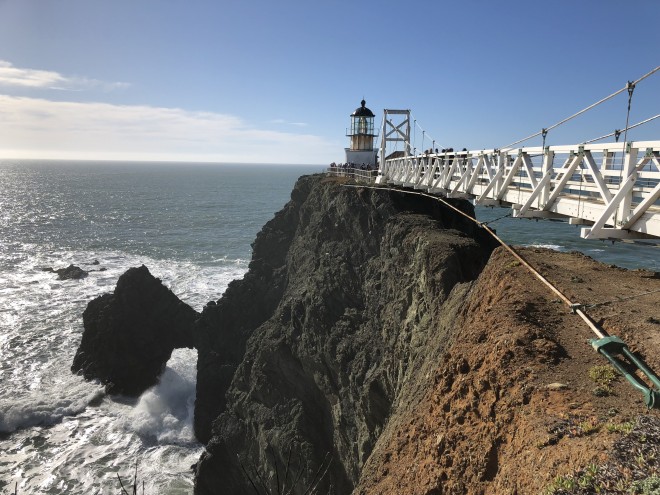
    Figured I’d end this post with some coastal pictures – taken up at Point Bonita the weekend before surgery.

  • Experience, expression, and meaning making

    I’m finding myself in a bit of a challenging position right now. I don’t know if it is a funk – or just kind of stuck. Typically, when this happens I go for a nice long hike and sort it out while I walk and commune with nature. However, after recent toe surgery (which is healing nicely), I cannot yet walk – and so, I’m going to try to express some of my thoughts in writing.

    One of my research questions is “What was my lived experience as a breast cancer blogger?” I realize that even with my narrative chapter – written in the form of blog posts from my time in treatment for breast cancer, I’m not really answering the question. In part, I don’t talk to the blogging aspect of the question at all, but also, how can one express lived experience? I think I have asked an unanswerable question – which is written a little in academic-ese – as the term “lived experience” is something meaningful to academics and signifies that what I’m answering is an ethnography.

    In the book Networked Cancer: Affect, Narrative, and Measurement (Stage, 2017), the author asks “Should [illness] narratives be understood as expressing life with an illness”? The question here is that of expression rather than experience. Narratives are necessarily only part of the story. Some narrative embellish, while others gloss over. There is always a reason or purpose behind the narrative. The narrative can never be the experience. In that way, I’m not asked “What was my lived experience”, so much is “how might my breast cancer treatment experience be expressed as a blog-formatted narrative?” That, indeed, is the question that chapter 4 of my dissertation answers. Maybe, part of my challenge is that I’m struggling with a nebulous question, which then makes it more difficult to defend the answer.

    The next part of my dissertation looks at what knowledges I shared on my blog, looking at the question “What knowledges did I share through blogging about my breast cancer experience?” My blog itself (http://bcbecky.com) is the data source (not to be confused with the blog-formatted narrative). More specifically, I’m using the blog posts from June 14, 2014 through February 3, 2015 – all 237 of them! as data. I’m looking at what types of things I shared on the blog – what things that could be considered forms of knowledge. Now, one could devolve very quickly into a philosophical question of – what is knowledge – which frankly, would cause me to have my eyes gloss over and make me question why I’m doing this whole PhD thing anyways – but to get it back on track, I asked myself the question – “what types of things did I share on my blog?”, leaving the definition of “thing” rather loose – looking more for patterns than anything else.

    This is how I came to the major categories in my theme research – which I then looked at each theme in more depth and drilled down again – looking at subthemes.

    The problem I’m challenged with now, is looking at the data and analyzing it as if I were not the person who lived the expressed experience in the first place. I listen to other’s comments on some of my posts and am fascinated by how much they see in my posts – but then I realize what they are seeing is not what I was expressing – nor does it have any meaning for me. It is an attempt at making meaning from the text that is written, when what I’m trying to do is make meaning out of the experience I lived – and I’m not sure those two things align – maybe they do – maybe, I’ll think though it and push through the resistance I’m feeling, and it will all click together – it has happened before!

    The sentence that really sticks out is this “it is an attempt at making meaning from the text, rather than making meaning from the experience“. Perhaps, I’m coming back to an impossible question – just like it is impossible to answer “what is my lived-experience”, it may also be impossible for me to make meaning from the text – frankly, I always hated that part of English class, where we attempted to analyze novels and such – attempting to derive some deep meaning from a written text, when each person interprets the text differently (and I didn’t ever really clue in that the goal in school was to figure out what the teacher interpreted from the text, because it was never really my interpretation that was being solicited – but that is an aside).

    The question I have now to answer is, where it is that I’m trying to find meaning in this process? My supervisors tell me that I have to not just present the data/results, I also need to explain what those results mean to me – I need to describe the meaning. It is OK for others to see meaning in my text that is different than the meaning I see. When I doubt myself, it is often because I am doubting that I can ever see the same meaning as someone else is seeing – but I am realizing as I type, that I do not need to see the same meaning. That doubt (and impostor syndrome) comes from misunderstanding – it comes from a voice in the back of my head that is telling me that I’m missing the meaning that others see, and that somehow, the meaning that I see is less worthy / less valuable than the meaning that others see – when really, the goal is not to find “the meaning the teacher wants me to find” like back in high school, but rather to find my own meaning in the data. I need to ask what does this data mean to me, and then explain what that meaning is and why I find it meaning that – I don’t need to be deheartened because I don’t see the meaning that others see.

    Now, I just need to figure out – what is my meaning – when I find themes and subthemes, I need to ask the question – what does this theme mean to me? Not what does this theme mean in general. However, I need to write it as if I’m answering the question “what does this mean (in general)” – because I’m writing the results of something that is supposed to be some form of “this is what I found, this is what it means” … and the formalized research report format leaves out the “to me” in the way it is written (and hence leads people to believe the data is less biased then it really is) … but that is another issue … so my next step is asking, what does this mean … and being OK if it means less or different things to me then it does to others who are reading my dissertation … because, the goal is my meaning making …


  • Normalcy of Surgery – and my big toe

    I am surprised at how I don’t think much of surgery – and yet I’m thinking about it. I’m preparing for it. I’m hoping it is as minor as the last time (Oct 2016). It will be slightly more invasive, as this time I have to be non-weight-bearing for 2 weeks – last time I could put weight on it the immediately.

    Tomorrow, I’m have Cartiva artificial cartilage implanted in my big toe. I’m hoping that it will relieve some of the pain I’ve suffered through for years. It bothers me most when I walk – and I love to walk. When it acts up, it bothers me at night. I don’t need to be doing anything – and flexing my toes hurts.

    And even with the ‘normalcy’ there is still a little bit of worry. Mostly worry in the logistics of it all. The inability to take an IV in either of my arms makes things likely more complicated. Since the surgery is in my foot, it mean that I only have one foot for a vein – otherwise they need to use a vein in my neck – something I am hoping to avoid.

    One thing that I am happy about is that I have a bunch larger support network now. I have friends in the area that can help me out – take me to appointments when my hubby is out of town. It feels so much better going into this knowing that I have friends that I can call on for help, or just companionship when I’m hobbling about – friends that I will drop everything to help if they need me. For that I am thankful.

  • As Dec 17 approached, I’m trying to figure out Christmas

    I bought my first ever real Christmas tree this year. It is a small tabletop tree – about all I could really handle. I’ve always had small trees – actually I had a Christmas pillar, and last year we decorated a Cactus out in the Arizona dessert. This year we are staying home so I figured we should have some kind of decoration. I also wanted to bring some plants into the house. I miss having inside plants.

    I have been trying to do a few different things to help me get into the Christmas spirit. I bought a cookbook. This one is made by the same folks who make my favourite gluten free pizza – Against the Grain by Nancy Cain. I’ve had some success with the recipes so far, and I’m looking forward to trying some more. I may even manage to make some of my traditional Christmas favourites with a decent gluten-free adaptation. Crossing my fingers. Either way, I’m enjoying the experiments.

    I also bought some fun emoji chocolate molds and made some emoji chocolate.

    But I just don’t feel in the Christmas spirit. At least not yet. I wonder if it is the lack of snow? Or maybe how I feel will change after December 17. December 17 is the three year anniversary of my double-mastectomy with immediate DIEP flap reconstruction – a 10 hour surgery – a surgery that removed the last of the known cancer from my body. In the past I have felt different on that day. I thought I might want to celebrate, but then I didn’t. Year 1 it was a day of sadness. Last year it was just another day. This year – three years – feels significant.

  • Mindfulness and CBT – A #yogamooc reflection

    YogaMOOC has caused me to reflect on the relationship between mindfulness and cognitive behavioral therapy (CBT). In the past I have been challenged with mindfulness instruction. In part, this has been because the instructors taught what worked for them, or what they had been told to teach, but what works for one person may be very different than what works for another. For example, I find that the exercise to focus on my breath really helps me, but I got nothing out of compassion meditation or body scans. For me, mindfulness is about the singular focus and the ability to see my thoughts and let go of them without judgement. I can do this when focusing on my breath – it doesn’t work nearly as well when I’m distracted by other meditations. But that is me. It will be different for everyone.

    In this sense, I see mindfulness as a way to practice seeing my thoughts, and separating me from my thoughts. When I practice mindfulness meditation, I see my thoughts as thought-bubbles, and I watch them come and go, trying to ensure that I don’t attach onto any of them. My therapist described it as “thought” as sense, like smell or touch. We recognized our senses, and mindfulness is a way to learn to recognize our thoughts as a sense.

    Cognitive behavioral therapy (CBT) on the other hand is about changing thoughts. The premise behind it is that you can change the way you feel by changing the way you think. The first step to any cognitive behavioral therapy is to recognize what you are thinking. Once you recognize it, you can categorize it or label it, then you can apply a technique to allow you to change it. Since I learned about CBT, much of the time I’m able to recognize my thoughts and fix them when they are broken. For example, I found myself procrastinating in writing my dissertation. I am normally very self-motivated, so when I saw that procrastination I knew there was something wrong. Further, I had told myself that I would ignore any symptoms that might indicate that my cancer has spread until after I finished the first draft of my dissertation. Somehow, my mind had translated that into ‘when you finish your dissertation, your cancer will spread’. It is completely illogical, but it was how my mind had warped one coping mechanism into another – which in turn lead to me procrastinating. Once I recognized what was going on (it is called ‘magical thinking’ in CBT language), I was able to burst that bubble. I know that my cancer will either spread or it wont and that has nothing to do with when I finish my dissertation. Those two things are not logically linked. By recognizing the thought patterns – stepping back and seeing them – I am now able to debunk the thought patterns and change them.

    In some ways, mindfulness then is the first step in CBT. First you need to recognize the thoughts you are having. One challenge I have is learning not to judge the thoughts. If I judge them as right or wrong, good or bad, then I cannot get to the root of what is causing the thought, nor can I figure out what technique to use to change the thought. I just need to recognize that the thought is happening and that it is a thought that I wan to change.

    Now to get back to working on my dissertation!

  • Don’t quantify suffering

    One of the things I learned in support group was to not quantify suffering. It is all too easy to find someone who has it worse off than you – but that does not make your suffering any less valid or real. And when we do this quantification, we are dismissing our own suffering and not acknowledging it – or we are dismissing the suffering of others, and not helping or supporting them.

    In the cancer world, it is all too easy to find someone who had it easier and someone who had it more difficult, but the experiences of others does not invalidate your experience. It doesn’t make your experience any less sucky. And those who have it easier than you still suffer. Their suffering is just as valid as yours.

    I remember when a friend passed and I was feeling sad, but I also didn’t feel like I had the right to be sad. I had empathy for her family who where going through so much more grief than me. A good friend told me not to quantify my grief. It is a message that has stuck with me. I see the same with suffering. Trying to compare suffering doesn’t make it any better.

  • Doctors think patients … and don’t talk down to me…

    I wasn’t sure right away what didn’t feel right, but upon reflection I realize that part of my viscerally negative reaction at the Health 2.0 expo today was the number of vendors that talked down to me the minute they realized I was a patient advocate rather than a doctor or tech representative. I guess the good thing that can be said is that they didn’t assume they didn’t talk down to me as a women, rather they waited until they found out I was a patient advocate.

    Then there were other vendors that were developing applications that doctors would “prescribe” to patients in order to increase “compliance”. My challenge, when I question them, they were developing their solutions based upon what doctors thought patients needed to know. They were addressing the reasons doctors think patients aren’t complying with directions. They never thought to get together a focus group of patients and ask them. Maybe, the are afraid that they will find out that they are solving the wrong problem. That the hospitals and insurers won’t pay for a tool that patients actually need, rather they will pay for tools that doctors think patients need (that is the pessimists in me speaking).

    For one demo, to be fair the folks at the booth (CEO and CTO I think) were quite receptive to my questions and suggestions. Now in writing this post I think I might be conjoining or convoluting more than one booth – regardless my point holds.

    The tool allowed doctors to prescribe the avatar for certain chronic medical conditions, like diabetes or heart disease  (they didn’t have cancer yet). The patient then could interact with the avatar, asking medical questions and getting medical answers. Further, the doctor is informed of the questions the patient has. It could also be used to allow the doctor to get information from the patient such as blood pressure (assuming home monitoring via bluetooth device).  My first reaction to this was that doctors already get more information than they can deal with – adding a way to give them more doesn’t sound like it is solving a problem. But I did realize a problem that I think their avatar could help with.

    I think the chemo situation is an interesting one. We are told right away to “tell our care team” and “don’t needlessly suffer”, but then when we do tell our care team they appear to completely ignore what we are telling them. At first you report everything. Then after a while you stop. You learn that your doctor isn’t going to do anything about it, or there is nothing they can do about it, so you stop telling them. In psychology terms this is called “learned helplessness”. It can be really dangerous, especially for chemo patients, because some of the side effects are life threatening. I saw their tool and thought, if it had a way to tell the patient “I hear you” in a believable way, it might be a way to help with the learned helplessness. Sometimes all the patient needs is validation. Personally, I think this learned helplessness problem is a big problem that often gets confused with a lack of compliance.

    The conversations highlighted to me that in some cases the tech companies are trying to solve what they perceive to be a patient problem by asking what doctors think patients need, rather than asking patients what they need. They seem to miss that if the end user of their tool is a patient community, that perhaps the patient community should be consulted as the tool is being designed. I don’t mean after the fact usability testing. I mean asking patients during the early design / concept phases whether they would actually use a tool, whether the tool would help solve the problem, and what the patients see as the problem rather than what the medical team sees as the problem.

    Tech can solve many real problems, but too often tech is thrown at a problem as if it is the solution without really analyzing what the problem actually is.

    Ya, that and don’t talk down to me.

css.php