BC Becky

Never Thought I’d Want to be a Breast Cancer Survivor

Tag: livingpathography

  • Recurrence and hormone therapy

    Even since Cancer Research UK posted an article reporting on a research report by Pan et al (2017), I have seen a lot of discussion on the topic of hormone positive breast cancer prognosis and hormone therapy.

    The article itself caused a lot of concern surrounding two key things: (1) the continued risk of recurrence through 20 years, and (2) anti-hormone therapy treatments. I want to talk about the second issue first.

    The inclusion criteria for the Pan et al (2017) research (that is, the women who were counted in the study) were those who were “scheduled to receive endocrine therapy for 5 years then stop, regardless of actual adherence” (p.1837). What this means is that the research study itself can in no way make any comment about the efficacy of endocrine therapy (also known as anti-hormone therapy such as tamoxifen or aromatase inhibitors).

    Confusion around anti-hormone therapy stemmed from this quote in the Cancer Research UK article:

    Gray said that the study shows it’s important for women with ER+ breast cancer to continue with their anti-oestrogen therapy for longer than the recommended five years. He hopes that these results will motivate women who are experiencing side-effects while on this treatment to persevere with it.

    The problem is, that the research report by Pan et al (2017) does not speak to the efficacy of hormone therapies. In the discussion section (this is where the researchers look at the literature and their research and interpret what it might mean), it says:

    Although reliable trials evidence is not yet available on the long-term effects of extending endocrine therapy for 5 additional years on mortality, an absolute reduction of a few percentage points in the risk of distant metastases over the next 15 years might well be possible even for such low-risk women, with correspondingly greater absolute benefits for women with larger tumors or node-positive diseases (p. 1844)

    The area of specific interest to me in the above statement is that there is no evidence yet on the long-term effects of extending endocrine therapy. It does no good to cure cancer if the cure itself kills you from heart disease or makes your bones crumble from osteoporosis. Endocrine therapy is not without risks, and often involves horrible quality of life issues.

    I want to talk more about what the Pan et al (2017) says. The research applies to easily stage survivors who were diagnosed under the age of 75 who has either stage 1 or stage 2 cancer with less then 10 lymph nodes involved. In addition, to be included in the study, patients had to be disease free after 5 years. The study looked at recurrence rates at the 5-20 year interval.

    Note also that in order to get 20 year data, it means that some of those who were included in the study were treated 20 years ago. Chemotherapy regimes and practices have changed, as have surgery techniques, since the time of diagnosis. The study anticipates that those who are diagnosed today will have statistically better outcomes than those represented in the study.

    In reading the article I was put at ease a little by seeing this image.

    screen-shot-2017-11-13-at-2-59-01-pm

    Although the risk of recurrence doesn’t stop over the 5-15 year period, it helped me to understand that my 20-year absolute risk isn’t my year-over-year risk. What I mean by that is, looking at the bottom yellow line, that if my 20-year risk is 15 percent, that doesn’t mean that each year my risk is 15 percent, rather at 5 years my risk is 3%, at 10 years it is 8%, etc. That actually made me feel better. For some reason, I had in my head that if I’m at a 30% risk, that I am always at a 30% risk – such that for any given day, I had a 30% chance of learning that my cancer had come back. That isn’t right thinking at all. The picture helped me realize how the statistics actually worked. It helped me feel less worried about where I am today. (note this is just one picture, there are a bunch of others in the report).

    It is still a bit of a blow to think that regardless of how long I live, I will have a risk of recurrence. I knew it, but it didn’t really sink in until I saw the graphs. What this also made me think is that because of my young age at diagnosis, the longer I live, the more likely the cancer will come back (assuming the slope of the graph follows as it has the first 20 years).

    There were some specific predictors mentioned in the report that I thought were of interest:

    Although all the women had been clinically disease-free for many years, the original tumor diameter and especially the original nodal status remained powerful determinants of late distant recurrence, even during the second decade after diagnosis. Within each TN-status category, distant recurrences continued to occur steadily throughout the person from 5 to 20 years. (p.1840)

    This is encouraging for me because my nodes where negative.

    Tumor grade and the presences of Ki-67 antibody…were important independent factors of prognostic value during the first 5 years but were of only moderate relevance thereafter. (p.1841)

    This is also interesting, as it says that the grade of the tumor (how fast it was growing) is a predictor for the first 5 years but less important after 5 years (still relevant, but only moderately so).

    And finally:

    The prognosis for women in particular TN categories has somewhat improved owning to earlier diagnosis, more accurate tumor staging, and better surgical, radiation, and systemic therapies.

    In conclusion, even after 5 years of adjuvant endocrine therapy, women with ER-positive , early stage breast cancer still had a persistent risk of recurrence and death from breast cancer for at least 20 years aft er the original diagnosis. (p.1845)

    Reference

    Pan, H., Gray, R., Braybrooke, J., Davies, C., Taylor, C., McGale, P., . . . EBCTCG. (2017). 20-Year Risks of Breast-Cancer Recurrence after Stopping Endocrine Therapy at 5 Years. N Engl J Med, 377(19), 1836-1846. doi:10.1056/NEJMoa1701830

    If you want to read the full article and are unable to access it, leave me a message and I’ll email it to you.


  • Authentic smiling as a coping mechanism

    In doing my PhD research, one of the things I noticed is that I took many pictures of myself smiling. This was done in part because I wanted to make sure my family and friends had lots of pictures of me smile (in the event that I didn’t make it). It was also done as a way to show my family and friends that I was doing OK.

    The thing about smiling is that when it comes from the inside, it does help you feel better. However, it isn’t something that should be ever forced on a cancer patient. Being asked / forced to smile doesn’t work. The positive effects of a smile work when it is something that comes from inside the person, not when it is a facade put on to benefit others.

    This week, I’ve seen many reports on this smile mirror – a mirror that forces cancer patients to smile. It is an example of a technology gone wrong. The forcing of a smile won’t help. Doing something that helps the person smile does help. Like how humor can help you feel better – nothing better than a good laugh – but forcing someone to smile just makes them feel worse. It makes them feel like their real feelings aren’t valid – that they need to put on a show for the benefit of everyone else – it just isn’t authentic.

    The creator missed the point – authentic smiles make people feel better – forced smiles make them feel worse.

    For me, smiling worked as a coping mechanism because it was me choosing to smile. Even when it was me putting on a smile for a photograph, it was still me making that choice. It wasn’t some stupidly expensive mirror app thing trying to force the smile on me – it was something that came from inside of me. That is why it worked.

  • Are you your disease?

    My research looks at the first 35 weeks of my personal experience with breast cancer as I’ve documented it on this blog. A couple of the themes associated with my dissertation data analysis relate to learning about the disease and negotiating identity.

    I think that this graph is particularly interesting:

    screen-shot-2017-10-18-at-12-22-52-pm

    When I look at this, I see that I did most of my identity negotiating in the early weeks – shortly after being told I had cancer. I’m pretty sure that I’d see a peak again later – but my analysis ends shortly after my major surgery, so I’m not dealing with all the post-treatment identity negotiation stuff.

    What struck me as interesting here is that in the first few weeks after being told you have cancer you are also learning a lot about the disease. Your healthcare team spends a lot of time educating you about the medical aspects of the disease and the treatment options. You spend a lot of cognitive energy dealing with learning the medical stuff.

    The only really emotional aspect that I remember my healthcare team talking about is that I’d need to learn to find a ‘new normal’. As a result, I’ve learned to hate the term ‘new normal’. I rebel against it every time I hear it.

    But what about all the identity negotiation that comes along with identity. If your healthcare team is spending so much time talking about the disease, does this not give you the impression that your healthcare team think of you as the disease. Is that impression something that happens because at the time in which you are struggling with identity negotiation, your healthcare team are focusing almost entirely on teaching you about the disease itself?

    In a post a I wrote on a couple of days after being told I had cancer I wrote:

    I am now thinking, that once all the unimportant stuff in my life gets peeled away, the essence of who I am will rise to the surface. That has started now, and I expect that as the weeks progress I will find out more interesting things about who I am.

    I’m struck the strong influence my doctors had over who I was, and how at the time when I was seeing a lot of doctors, that I was also questioning who I was, and what this diagnosis meant to me.

    Am I my disease? No. But the disease did shape who I am today – there is no avoiding that.

    It has me wondering though, what can we do in those early days to better support patients who are dealing with cognitive overload around learning all the medical stuff about the disease while they are also having to deal with all the emotional and mental work that goes into negotiating identity and how that identity is fundamentally impacted by the diagnosis? Is there an ideal time, when there is a pause in learning about the disease, where the identity would could be done – as a way to help smooth some of the waves and chaos at that time? What support do you wish you had at that time? What else could you have handled?

  • The complexities / interplays of trust

    One of the “themes” that has emerged in my dissertation study is that of “learning about the disease”. When I look at the types of information I shared on my blog between diagnosis (June 12) and active recovery (Feb 3) is that of learning about the disease. I’m looking at the different ways in which I found myself learning about, and sharing knowledge about breast cancer. There isn’t a simple path – first you learn from A, then B, then C – it is a whole lot more complicated than that.

    I have commented several times that a friend very early on in the journey has recommended that I should “decide who I trust, and trust them”. I use that mantra quite regularly when I am second guessing what I think might be happening.

    Add to it the complexity and lack of clarity – you see, cancer treatment, and more specifically breast cancer treatment, isn’t clear cut. Yes, there are certain protocols that are followed in certain circumstances, but there is a whole lot of complexity – and that complexity means that there is never one and only answer. As we like to say in the design world, there isn’t one ‘right’ solution, it is just that some solutions are better than others.

    Now, if we look at all the different places I found information:

    • My body
    • Google (open searches)
    • Doctors (primary care, radiologist, breast surgeon, oncologist, plastic surgeon … )
    • Nurses of variety of sorts
    • Test results (pathology, MRI, ultrasound, blood tests)
    • Organizational websites (e.g. breastcancer.org)
    • Blogs
    • Face-to-face support groups
    • Online support groups
    • Friends
    • Family

    The list goes on. In some cases these different information (and advice) sources overlap. In others they don’t. I had to learn how to discern not only where I could get information, but also what types of information I could get from where, and how reliable that information was. There were so many nuances to information that I didn’t always appreciate at the time, and some that I still don’t appreciate.

    Three years later, although I have a much better sense of information and where to find certain types of information – I’m still finding the ground constantly changing. I think I know something, then something happens that causes me to question what I’m thinking. I doubt. I freak out. I go into high gear trying to get answers. I trust someone / something. I relax, but only until the next time it happens. I only hope that there will be longer gaps between issues.

    I have those of my healthcare team that I trust. I also hear stories, horror stories, from others that have me questioning – not my care team directly, but some of the facilities around my care team. Can I trust that pathology report? Can I trust the radiologist? Hearing the experience of others sometimes makes it more difficult to trust. I hear how others put blind trust in the system, and that trust failed them. I find myself being thankful for not having been so blinding in my trust. But then I also find myself stressed over things that I should not be. I find myself questioning things I need not question. The danger of being a well informed patient in part comes when the doctors forget to tell you things assuming you already know. Or when you think you know things so you don’t ask. Or when you doubt what you are being told. Blind trust can be dangerous; however, intentional trust can be liberating…the goal is to distinguish between the two.

  • Infusion-fatigue

    As I work through my research data coding, I’m having to read and re-read and re-read… the BCBecky blog posts from the beginning through February 3, 2015. Some of the posts are particularly emotional, as the memories come flooding back. In others, my memory of the time is totally different.

    When reading about my chemotherapy experience, and especially the Taxol experience, I realized something that no one told us when we were making our decision about chemotherapy options. We decided on weekly taxol because we were told it had less side effects (smaller dose). Since we live close enough to the infusion center, we figured that anything that reduced the side effects was the better choice.

    Looking back at it, I find that I wished I’d selected the chemo every 2-weeks (higher dose, but only 8 treatments rather than 12). At least I think that was the option – something like that. The key reason I wish I made the other choice was that I found that 1 week wasn’t giving me enough time to recover before the next infusion. But now, I have a different thought – perhaps what I was suffering from was infusion-fatigue.

    I had read about patients experiencing surgery-fatigue, that is, not wanting to deal with yet another surgery, such that they delay or don’t complete reconstruction. That was part of why I opted for immediate nipple-sparing reconstruction – I managed to finish with only 3 surgeries. I didn’t run into surgery-fatigue.

    When I consulted with pain management, the doctor mentioned the idea of pill fatigue. One of  the key reasons I couldn’t manage the dose of gabapentin they recommended was because it involved taking too many pills too many times per day. Fortunately, there is a 24-hour time-release version, which costs a fortune, but is something that I can and do take. It has been life altering.

    This got me thinking about one of the factors in choosing a chemo regime should be the consideration of infusion-fatigue. This explains what I was suffering from in my post Grumpiness and Mentally Preparing. It is a consideration that I do not recall ever being mentioned.

  • Not fighting a battle – the closure to the narrative is death itself

    Recently, I read a book chapter by Arthur Frank (2009) titled “The necessity and dangers of illness narratives, especially at the end of life”. It got me thinking.

    One of the pet peeves among many cancer bloggers as well as those with metastatic breast cancer is cancer as a war metaphor – that is, the fighting a battle with cancer language. Many people don’t like suggestion that those who died from breast cancer “lost”, as if they did not try hard enough, as if breast cancer was something that involved winners and losers.

    In the article Frank says that “narrative thinking embeds the idea that obstacles must be overcome for there to be a closure. Moreover, obstacles are necessarily understood as a personal test, conveying a sense of individual victory or defeat.”

    If I look back on my experience, there was a time where I identified as a warrior. The metaphor worked. I was in chemotherapy and suffering from a variety of side effects. I needed to fight to keep exercising and do my best to keep strong. The war metaphor worked for me. It motivated me. In reflection, I see that it worked because I needed the sense of closure. I needed to know that the immediate experience I was having would end. To mentally make it through all the suckiness that was chemotherapy and then surgery recovery, I needed a sense of ending. So the war metaphor gave me a sense that there would be closure to that part of my life’s narrative.

    But now, after acute treatment for early stage breast cancer, I feel that the war metaphor no longer works. It doesn’t work for my friends who are metastatic and will die from this disease. But it also doesn’t work for me. With survivorship, one of the things I am coming to terms with is that there is no sense of closure. There is no clear ending. The war metaphor no longer works for me. I’m living with all the side effects of treatment, and with all the fears of the cancer coming back, or another cancer happening. I do not expect that there will ever be that pretty closure that narratives seek. But I also think that is part of the point.

    It got me thinking about why the war metaphor works for some people. With the war metaphor there is an a sense of ending, a sense of closure. But for most people with breast cancer, the only ending or sense of closure is death. It is not a narrative that is meant to have closure. The need for closure takes away an aspect of the experience that is paramount to those who are surviving after breast cancer treatment. You don’t know that you “survived” breast cancer until you die from something else. And those who do die from breast cancer, don’t lose a battle, they die. The sense of closure in the narrative is death. It doesn’t need to be a battle lost. It shouldn’t be a battle lost.

  • Remission society and mourning my fantasy future

    Remission society and mourning my fantasy future

    I apologies to those who read all my blogs, as I am cross posting this. I’d love to hear answers from the various readers of my different blogs.

    I want to connect two ideas: the idea of remission society as described by Arthur Frank (1995), and the concept of the fantasy future that I learned while on a cancer care retreat at Commonweal (February 2015).

    Frank (1995) explains that anyone with a chronic illness lives in the remission society. Frank (1995) describes how “in modernist thought people are well or sick. Sickness and wellness shift definitively as to which is foreground and which is background at any given moment. In the remission society the foreground and background of sickness and health constantly shade into each other” (p.9). I interpret this as the way in which I shall never not be a cancer survivor. Breast cancer is a sickness that will always be part of my identity, regardless of how healthy I am at any given moment. It also will always affect my wellness. I will never be well in the same way I was well before cancer. I may be in remission, where I am not sick but nor am I well. I think of remission as this space in-between, or perhaps above or below, not on the same axis as the well or sick dichotomy.

    In order to deal with my emotional wellness, I needed to address the loss of my place in the well category in the well or sick dichotomy. While in active treatment, I was clearly in the sick category; however, once chemotherapy and surgery where done, and the last of the known cancer was removed from my body, I was no longer in the sick category, but also was not in the well category. I was in remission. It was learning of the falseness of this dichotomy that helped me move beyond it. During a group therapy session, the therapist made a reference to the idea of a fantasy future. That is, the concept that all futures are a form of fantasy. We imagine what our future life might entail (e.g. growing old together, remaining in perfect health), but the reality of life is never what we had imagined. A big part of my emotional healing was to forgive my body for the loss of my fantasy future.

    Another part of this reality, and one that I’m still working on, is that it should help me focus more on the present. What is in the now, and the short term future, rather than the long term future. This is, in theory, to help reduce anxiety today, but focusing on today rather than focusing on the uncertainties of tomorrow. However, this of course causes the problem I describe in my paradoxical future. Where I struggle with the challenging balance between planning for the future and seizing the day.

    Perhaps that is in part what it means to be in the remission society (as opposed to being sick)? When I was clearly sick, my focus was on a very short timespan. I saw life on very short horizons – tomorrow, next week, next month – never more than three months. I just couldn’t plan that far in advance. But now, after I have mostly healed from chemotherapy and surgery (I say mostly, because some of the damage will never be healed), I see the potential for those horizons. It is because I see them only as potential and not concrete that I run into the paradox. Sure anyone who is well will say that they don’t see the future in concrete terms, but in the scale between potential and concrete, a well person sees the future a lot more concretely and someone who is sick, who only has a sense of potential for the future. In this world of remission society, I’m somewhere in the paradoxical middle. Afraid to have a fantasy future, because I got burned by that idea.

    Do you have a fantasy future? How concrete is your sense of future?

    Feature image CC0 via MaxPixel.

  • Circle of 6

    One of my students is using the Circle of 6 app in the course she is designing. In looking at the app, I found myself thinking that it might be a useful resource for ePatients – especially in the chemo and post-surgery. I totally see times when my husband went to work and I was alone in the apartment. If I ran into trouble I could use the app to say “hey, I need help”.

    The app itself was designed to help people who are at risk for experiencing sexual assault, but I could totally see how it might apply to patients.

    What do you think? Is this an app that you might find useful?

  • Overwhelmed with a huge sense of denial

    Overwhelmed with a huge sense of denial

    As part of my PhD research, I’m reading through this blog. It is an interesting experience. I wrote the blog, but I haven’t really read it. And I certainly haven’t read through multiple months at a time, from the beginning tracing through my journey – reflecting on what I wrote versus what I now remember of that time – thinking about the things that I didn’t write about.

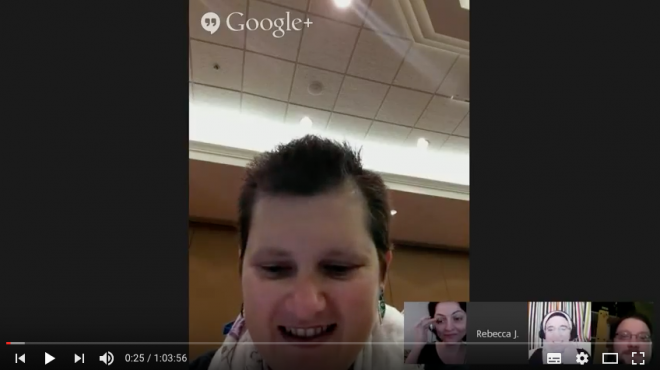
    Today, I read a couple of blog posts from a pretty transitional time. It was my first academic conference that I travelled to after cancer – Emerging Technologies for Online Learning or #et4online. The previous years conference also happened to be the last conference I went to before my diagnosis. I wrote about my first day and how tiring it was and how I found myself negotiating my new identity, but also the second day where I laughed so hard at karaoke that my abs hurt, then went back to my room and cried.

    The #et4online conference turned out to be a rather transitional conference – in that it was the conference were #et4buddy began – which has since been renamed and thrived as Virtually Connecting.

    One of the things I didn’t write about was how I was really self-conscious about my hair before the conference and on the first day of the conference. In posts from earlier that month, I had written about how my grey post-chemo hair was driving me crazy to the point where I dyed it. It was thin. The first session that we did I was wearing a headscarf to cover it – but the next day I decided I didn’t care. I let go of my self-consciousness. I styled my hair into spikes because that is all I could do with it. It was thin. My scalp showed through – or at least that was my impression – and yet I decided I didn’t care. One of the reasons #et4buddy worked was because I let go of all my self-consciousness and worry, and just went for it.

    Upon reflection, that was really a transformation in my self-confidence. Once I stopped worrying about what I thought other people might think about me, I was able to just be myself. I was able to let go and enjoy myself, but also to be myself with a level of self-confidence that I have never had before. I stopped caring about how other people might superficially judge me. It was like letting go of a weight that had been holding me down.

    Within that same timeframe I became more aware of who my blog audience was. When I started the blog, I saw my audience as my family and friends, but also as healthcare providers. I even wrote posts specifically to healthcare providers (I still do from time to time). But, at some point, I realized that my primary audience was actually other breast cancer patients. I was sharing the details of my journey in order to help others understand their journey. I shared my coping strategies but also my decision making processes. Sure, sometimes articulating my decision making processes was so that my family better understood my decisions, but mostly it was to help other breast cancer patients make their own personal decisions.

    Another area that I am noticing is my changing view of what it means to be an engaged patient and what it means to be a patient advocate. I struggled with what my advocacy was. I still struggle with what my advocacy is, and what that will mean in the future.

    And yet, as I read through all this I’m also overwhelmed with a huge sense of denial. I feel like I am not living in this body. I am looking on the past three years of my life as if it didn’t all happen, as if I am not in the position that I am in today. I feel like I want to just stick my head in the sand and pretend it all way. I want to wake up and have it all be a bad dream. No, I’m not a breast cancer survivor. That didn’t really happen to me. But I don’t need to pinch myself to know that it did happen. I just need to look down at my hacked up body. I see the scar that runs from one hip bone to the other, and the numb appendages on my chest that look like breasts but don’t feel like anything. And I know that I am not having a dream. I find it funny that I write this and yet in the same breath I talk about my improved body image! But I also look at my accomplishments. I look at how I have a much healthier sense of body image. Shedding my fears of what other people think of me has made me a much more confident teacher. Pushing through recovery and regular exercise means I am hiking and swimming further than I though I ever would. I am getting stronger every day, and that is something that I cannot deny.

    Feature image from #et4buddy Hangout on Air.

  • Identity

    As part of the PhD process, I’ve been reading through my blog from the beginning. I wrote it, but I have never actually read it – at least not in this way.

    I am immediately struck by how my memory of the time doesn’t completely align with what I wrote. I know that what I wrote was a much more accurate reflection of what I was thinking than my memory of that time. There are a few places where I realize that what I wrote doesn’t even begin to capture what I was feeling – I can tell when I was holding back to help protect family members who were reading – but there were many times where I was fearful, in pain, and honest about it – that I don’t actually remember – at least until I read about it.

    I’ve also been struck by how well I managed to write through (and see) brain fog. Now I know there are additional brain fog moments – which I haven’t gotten to year – but certainly the early days of taxol, and the cognitive challenges I was facing – I wrote about in some detail. I will write more about this later, once I’ve read more, as I know that my cognitive issues continued for much longer than I realized.

    One of the themes of my posts have been my exploration around identity. Heck, the subtext of this site is “I never thought I’d want to identify as a breast cancer survivor”. I was deep into exploration of my identity when I got diagnosed, so it was definitely something that was on the forefront of my mind when I started this blog. What I find interesting now is that the things I was worried about then no longer worry me. I care a lot less about what other people think of me. I’d be naive to say I didn’t care, just that opinions of others are generally less of a concern to me now. It is less of a reason for me making the decisions that I do.

    I also wrote a lot about body image. I wrote about my concerns as I was making a decision about surgery. I remember being so opposed to and incensed by reconstruction, and then that changed – and yet the blog doesn’t even begin to express how strong my feelings were. In so many ways, in my memory of that time, I was over-amplifying my outrage in order to compensate for my true desire to reconstruct.

    Today was a bit of a landmark day – well maybe not landmark but important. Over the last few months, I have been showing a little of my naked body in the gym change room. Not usually a lot, but really, I was becoming less and less worried about putting moisturizer on my scars before putting my clothes on. In early days, I would only do this in the shower stall, where I knew I had complete privacy. Today, I chose not to worry in any way. I let my towel drop to my feet, and slowly applied moisturizer before putting clothes on. I just didn’t care anymore. I felt like I was even challenging others to ask the question. If anyone stared, it would be a great conversation starter. If someone asked about my scars or my surgery, I could explain, no this was not a cosmetic choice, rather it was cancer that forced my hand. I was OK with it before, but today, I was just a little more brash about it. I just didn’t care what other people thought.

    I actually seem to have much less of a concern about what the future may hold. If things don’t go well with our green card application, and we end up moving back to Canada sooner than planned, I’m much less worried about it. I used to worry about having to let go of my doctors – not that I’d want to – but now, I know that I’d be ok with going with the flow. Sure I wouldn’t be happy about it – I don’t want any external factors forcing my decisions, but I also know that I’d manage to do OK regardless of the circumstances.

    Today, I’m 3 years older than when I was diagnosed. I’m looking forward to celebrating many more birthdays. Who knows where (or who) I’ll be at this time next year!

css.php