BC Becky

Never Thought I’d Want to be a Breast Cancer Survivor

Tag: Learning about the disease

  • Breast cancer prevention

    It is with mixed feelings that I read about breast cancer prevention. It is not that I want anyone to get breast cancer, I would not wish that on anyone. It is just that when I read about prevention, I enter that world of regret. I start running through the if onlys

    …if only I had thrown out the water bottles with BPA sooner
    …if only I ate less red meat
    …if only I ate less sugar

    In general, I’m very good at not regretting the past. There is nothing I can do about it now, so no point in dwelling on it right?

    But still, when I hear of a charity that focuses on breast cancer prevention, I’m filled with both regret and doubt (can we really prevent breast cancer?).

    One charity that works to help prevent breast cancer by providing public advocacy and education campaigns based upon scientific evidence (not personal opinion – there are way too many personal anecdotes about what causes cancer!) is the Breast Cancer Fund.

    On October 11 (Canadian Thanksgiving Weekend), Scott and I will be doing a day hike that is a fundraiser for the Breast Cancer Fund. It is a good chance for us to meet some new people (we’ve joined a team captained by a friend-of-a-friend) while going on a hike up Mount Tam in Marin County (just north of San Francisco). It is an area that we haven’t yet explored, so that too should be fun. Mostly, it is a great excuse to get out, and help me get motivated to train for my walk down Mount Haleakalā in December. As this is a fundraiser walk, we could use a little help with fundraising …

    To support Scott’s hike: http://prevention.breastcancerfund.org/goto/scottd

    To support Becky’s hike: http://prevention.breastcancerfund.org/goto/rhogue

  • Persistence, Tenacity, and New Blood

    Persistence, Tenacity, and New Blood

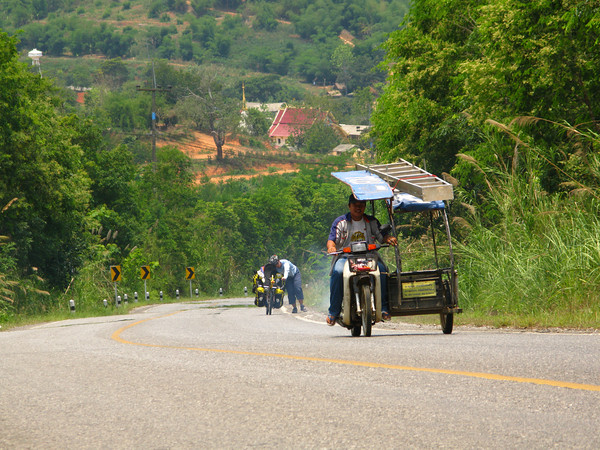
    This cancer journey reminds me of some aspects of our Going East bike trip – particularly during those times when persistence and tenacity are what you need to make it over that one last hill. I always thought this picture from our trip made a great motivational photo (Scott pushes the loaded recumbent bike up the mountain – you can see the sweat on his back – unfortunately the picture does not do the steepness of the hill justice). The locals thought we were crazy trying to bike over this mountain pass – but we were both persistent and tenacious and we made it!

    OK, this is steep

    Perhaps this is a better persistence picture (also in northern Thailand):

    Photo & Video Sharing by SmugMug

    My point here, is this is how I feel when I’m feeling fatigued. I feel like the entire road is uphill. And although these pictures show a struggle, they also bring a smile to my face. They remind me of challenges that I have overcome. They provide me with that little extra reminder, that yes, I can do this.

    Yesterday, I had my first transfusion. The AC chemo was knocking out my red blood cells (RBC), and they were not being given enough of a chance to bounce back between rounds. Folks have asked about drugs to help with RBC. Apparently the drugs take a long time (6-8 weeks) to boost production, and the side effects can be worse than the side effects of a transfusion. Given the more immediate need for a boost now, it made sense. And so, I had my AC chemo on Monday and a transfusion of two units of RBC on Tuesday. I cannot say I immediately feel better – but then the AC chemo knocks me down for a few days, so it is hard to say. What I can say is that I have more colour – my cheeks are pinker and my lips have natural colour again. I had not really realized how pale I was before the transfusion.

    Unfortunately, my phone doesn’t take very good photos.

    Photo & Video Sharing by SmugMug

    We were also serenaded by the harp during treatment, which was nice. Apparently, med students who are also musicians volunteer to play in the cancer center. This is the first time we’ve seen the harpist directly in the infusion treatment area.

    The volunteers at the hospital make the nice head scarfs/hats. I discovered that it works well when the tie is on the side – kinda makes me think I should learn to read tarot cards.


    So, now I have some new blood. I am still feeling some fatigue, but hopefully in the next day or two I’ll bounce back :-).

  • Every day a new side effect

    Chemo has many side effects, so many, that they don’t tell you about them. What happens is, when you have a symptom, you contact your oncologist (or the oncologist on call) to see whether or not it is something you should worry about. There are so many side effects, many of which are rare or not that common, that listing them all to every patient would be impossible. But, from the patient perspective, I find myself constantly running into these odd side effects. I’m happy to be part of several support networks (both face-to-face and virtual). The virtual networks in particular are useful for finding out whether something is “call the doctor immediately” or “pretty common, mention next time your are talking to your oncologist”. For the most part, my oncologist has not been concerned about the side effects I’ve experienced. It seems to be though, that ever day something new pops up.

    Yesterday’s new side effect was loss of voice. Not a total loss, but I notice that suddenly my voice is horse and it is more difficult to speak. This of course posses and interesting challenge, as I also have blisters on my hands from toxic erythema of chemo, which I also experienced last cycle. When the blisters are at their worst, typing can be painful, so I use voice-to-text on my computer. The horse voice makes that a little more challenging. I actually don’t know for certain yet if this is a chemo side effect or if there is something else going on, but my social networks tell me it is not uncommon. I just haven’t yet had that confirmation from my oncologist.

    I’m also loosing my hair. Now, this is something that was expected, and it was why I shaved my head in advance of cycle 2. However, when people say  that hair loss usually occurs on days 3-4 of cycle 2, I expected it to be a single day event. That isn’t really what is happening. My hair is getting thinner on various parts of my body. From the front, you don’t really notice the hair loss on my head (which made me think it wasn’t happening), but from the back it is pretty clear. It is also interesting to compare mine to Scott’s, since we had them shaved at the same time. His is growing, mine clearly is not. It is actually the towels where I notice it most. I’ve taken to using two towels after a shower, one for my head and one for my body – otherwise, I end up with the little hairs from my head all over my body!

    2014-07-28 19.35.32Once the hand sores finish up, I prepare myself for the mouth sores. I’m now at a stage where food is tasting funny and my mouth feels fuzzy, like a layer of skin is shedding in my mouth. Last cycle I had a sore on my tongue which was rather annoying and painful. Food was finally tasting good, but it hurt to eat (ugh). I’m hoping that by using the magic mouthwash in advance I manage to avoid the worse of the mouth sores this cycle.

    Today was also my last swim until after my chemo nadir (blood count low). I have three days (8-10) where I cannot swim as my risk of infection is too high. I’ll miss swimming, especially if my hand sores aren’t healed  as biking isn’t an option when I have blisters on my hands. This actually also coincides with fatigue, so last time on day 10 all I did was sleep all day.

    All that being said, so far cycle two has not been as bad as cycle 1. I think because I have a better idea of what to expect, I can be more proactive about managing what is happening. I can also plan my weeks out better. I now know not to commit to things on specific days, but on other days I can be more flexible. That helps. The control freak in me is feeling more in control of what is happening.

  • Breast cancer pet peeve – it is not a “lump” (public service announcement)

    My breast cancer pet peeve of the day is the word “lump” … cause, well, it doesn’t FEEL like a lump! The word lump actually is misleading and causes too many women to NOT get something checked out. It is part of why I waited a week (fortunately, I only waited a week).

    So, first and foremost – get to know YOUR breasts. I checked mine every time I got in the shower. I suds up with soap and feel around and inspect. I also look at myself in the mirror and look down when I dry myself off. So, when something changed, I noticed!

    Many women have lumpy breasts. Some of the normal tissue in your breast feels lumpy. It isn’t the normal lumpiness that is the problem – it is the change that is problem. The first I heard of nipple retraction was AFTER I was diagnosed. What I noticed was a hard spot – an area that felt firmer than normal – which I initially associated with what I thought might be a muscle strain, but when it didn’t away I got it checked out.

    Screen Shot 2014-07-20 at 12.54.15


    Above is a MRI image of my left breast. It shows the two masses. The upper is a known malignancy – this is the one I felt and it is my largest mass (depending on the scan measuring somewhere between 3 and 4.7 cm in its widest dimension – MRI measured it smaller than ultrasound but they won’t really know until they take it out and do a full biopsy on it). It is not a regular shape – it is not this nice round “lump” – rather it is an irregularly shaped mass (it doesn’t look 3 cm in this angle, they measure it in three dimensions based upon the largest size). The bottom mass shows up on MRI only (I’m getting it biopsied tomorrow) – it is suspected to be cancer only because I already have a known malignancy. The point I wanted to make on this picture was the irregular shape of my breast. I can visually see when I look in the mirror, while looking down that my left breast isn’t smoothly curved. This is a sign that something is WRONG!

    BTW –  I think it is way cool that I can just sign a form and they mail me CDs with all the images from scans that have been taken. I find the MRI images particularly interesting. I get a full copy of the radiologist’s report, so I know which images are most interesting (there are 15,000 images from a standard diagnostic MRI).

    So, if you don’t do annual mammograms (and even if you do), it doesn’t hurt to just ‘cop a feel’ and check out your breast EVERY time you hop in the shower …

    OK… done with the public service announcement for the day. Time for a bike ride!

  • Chemo day in pictures …

    Photo Jul 07, 7 28 10 AM

    Step one was to have the access placed into my port. This allows the nurse to draw blood for blood tests, but is also used for the infusion of chemo itself.

    Photo Jul 07, 7 53 15 AM

    Since they need to wait for the blood test results, we had about a half hour between the blood draw and the appointment with the oncologist, so we went over for the standard tree picture. This one indicates how I was feeling.

    Photo Jul 07, 7 53 09 AM

    And here is the more typical me with a smile on!

    Photo Jul 07, 10 33 47 AM

    My first reaction came at all the pre-chemo drugs. I’m still not certain what they all were. Three of them were anti-nausea drugs and one is a steroid. I thought we had the print out of what they all were but I cannot find it.

    This is the Doxorbicin (or the A in the AC regime). It is administered directly by the nurse. It was followed by Cyclophaphouride (C) which was a 1 hour IV drip. Although the appointment was for five hours, it didn’t take that long. I totally broke down when she brought the tubes of red stuff – but not nearly as much as I expected I would. The emotional breakdowns are inevitable.
    Photo Jul 07, 10 15 01 AMThis one was actually taken at the beginning while we were waiting for the nurse (notice the IV isn’t hooked up yet). Afterwards I was looking a little on the green side – but not feeling too bad. The steroids wore off at about 3-4 pm and the nausea started to kick in. Hope that ends today!

  • Long day at Stanford

    Photo & Video Sharing by SmugMug  Photo & Video Sharing by SmugMug

    Our day began by driving up to Stanford early so that we could avoid too much rush hour stress. We decided to check out breakfast at the cancer center. We shan’t be bothering with that plan again, as all the options involved eggs which I cannot eat that often. Oh Well. The coffee was good.

    Our first appointment was with the surgeon. They had also scheduled an MRI, but we were not sure if we were going to stick around for it. We would only do the MRI at Stanford if we thought that I’d be seeking treatment at Stanford as they prefer the MRI be done at same location.

    We immediately noticed a difference. The automatic assumption was not mastectomy. They began the conversation with the assumption that a lumpectomy was an option. Actually, the surgeon I saw specializes in nipple sparing techniques. An important comment had something to do with 10-15 years and same mortality rate for both mastectomy and lumpectomy with radiation. I’m not 100% certain how I heard, so we are asking for clarification. The idea was though, that lumpectomy, plus radiation and minimal reconstruction is a real option. When we go back up, she wants me to also consult with a plastic surgeon. So, the result could be two smaller boobs – rather than no boobs. One interesting side-effect of radiation is that the breasts don’t grow (or grow slower) – so if you gain weight you don’t gain breast. This is an issue if you have only one breast cancer, as you can then become lopsided post-surgery. With both, this wouldn’t really be an issue. Upon reflection, Scott commented that you could really tell the doctor’s passion – she was passionate about creating the best outcome for women long term – so an outcome that would make them happy with the results well after the cancer.

    Throughout this process, everyone has been very clear to highlight that cancer treatment is an individual choice. They provide you with the options, and in the end you need to be the one that decides which option to take. Some of the best advice I have received is “you do not need to like all your doctors” and “choose who you want to trust, and then trust them.”

    I was sent for an axillary ultrasound (ultrasound of the armpits) as that had not been done at PAMF. So far, no one has found any lymph node clinically (that is by feel), and the ultra sound is done to see more detail. The ultra sound saw nothing on the right and wasn’t determinant on the left, but there is swelling from the biopsy so nothing was clear.

    We met with the oncologist, who I really like. Actually, almost immediately I liked him. I’m not sure why, but I felt that I could trust him. He examined me then went off for a bit, and when he came back he brought in the surgeon and the fellow (surgery fellow) – so I had all three doctors in the room talking to me at once (that was kind of nice). We all talked briefly because I had the MRI appointment, and 4pm was fast approaching.

    In general, we don’t yet have enough information for a treatment plan (we knew that). They wanted to see the MRI results and more importantly the HER2 results. As far as everything we have seen so far, all indications are that the lymph nodes are clear (good thing). If the HER2 is positive (I would then be triple positive), then the HER2 regime would be indicated before surgery (I got a sense that this is the expected outcome if indeed I the tumor began to grown when I think it did). One benefit to doing something before surgery is the chance that the tumor might shrink. Shrinking the left tumor would make surgery easier – especially if the surgery is a lumpectomy.

    If I were to be HER2 Indeterminate (not positive), there was a potential clinical trial (because even with HER2 Indeterminate, I still had some HER2; however, I didn’t qualify because of the second breast cancer). The difference would be have been the post-surgery treatment.

    The day ended with an MRI. It is perhaps the oddest thing I have ever experienced. Unlike all the pictures, you are in the MRI machine on your stomach with holes for your breasts to hang down. The test took 30 minutes, and it made the oddest sounds. At one point it sounded like a fire truck was whizzing by. Other times it was clicking, and then shaking. There were whirs, honks, and other sounds that somewhat reminded me of the sounds on the container ships. Truly, it was perhaps one of the oddest experiences I’ve ever had. When the test was over, and I got up, I was struck by how sore I was. I had not realized that I spend half an hour laying down with a large portion of my body weight on the center of my chest (as my breasts where hanging) and my arms were above my head. I’m not really looking forward to future MRIs!

    When we got home, we both collapsed. It was a rather exhausting day.

    Although I didn’t like the initial feel at Stanford (there were a lot of sick people walking or being wheeled around), I did really like the doctors. More importantly, I felt a level of trust with the doctors that I don’t think I felt at PAMF. At PAMF the doctors are all really nice, but I wonder if they are too conservative. I think I would be happy there if I had simple breast cancer, but I don’t. What I like about PAMF is that I didn’t have to see a lot of other sick people, so I didn’t feel sick. At Stanford, there was obviously a lot more people being treated for a lot more serious disease. It makes sense, but it did make me feel for the first time that I too was sick – which given how exhausted I was when I got home … however, after a nap, and some food, I’m feeling a lot better. I’m hoping that I wake up tomorrow with more energy as I’d like to get in a decent bike ride … too much of the last two days has been spent indoors.
  • Humour in the moment – which boobs should I wear?

    In this moment, we (Scott and I) often find ourselves laughing at things that are rather absurd, but real none-the-less. I recognize it clearly as a coping mechanism, and something that is definitely needed. But I’m also aware of how easily something funny can turn into something not funny.

    I recall back in my undergrad days, one of my friends had cancer. She had cancer before I knew her, and had a re-occurrence. I did not know her well, but well enough that I remember her clearly. Last I had heard she had two beautiful children and was doing well. I mention her because of a particular story. At her wedding shower (she had recently been diagnosed with the re-occurrence), we were laughing about this or that, and for some reason the jokes turned to wigs. There was laughing at first, but then a sudden transition to tears. This is what I’m aware of every time I laugh about something. I’m aware that at any moment that laugh will turn to a cry.

    Today’s laugh was about prosthetic breasts. I never even occurred to me that one would make special prosthetic breasts for swimming. They even make aerodynamic (or I guess aquadynamic) prosthetic breasts. Who knew? I was reminded of Aimee Mullins TED talk about her 12 pairs of legs. She talks about how having various legs allows her to be different heights. She talks about legs as things that allow her to specialize her superpowers (when she wants to run fast, she has special legs for that). So that got me thinking about fake boobs. You see, if I don’t opt for reconstruction, and if I end up with cancer in both then I too could have multiple sets of prosthetics for multiple purposes. I could have bigger boobs to fill out my favourite shirt, or smaller ones when I want to appear more professional. Then of course, it occurs to me, that people who saw me regularly would find it rather odd that my chest size kept changing, and how would you go clothes shopping? Which boobs would you wear? And if I were to get into competitive swimming, would the boobs I choose to wear affect how fast I swim? Would that be considered cheating?

    In all seriousness, I am thankful that the surgeon highlighted that a mastectomy is a real possibly. Not that I want one (the whole idea scares the crap out of me), but that I have a little more time to mentally prepare for it. When the diagnosis is in, and the treatment options are presented, I will be better prepared to make a decision. I at least will have had a chance to explore the options. It never would have occurred to me to search the Internet for breast prosthetics. My fear of being ‘lopsided’ does have some solutions – but frankly, given that I hate wearing bras, I’m still dealing with choosing between two bad options. Reconstruction means more surgery, more complicated surgery, and more healing time. No reconstruction means a life of prosthetics (at least for formal settings).

    On a related note, Scott and I went for a walk around Sausalito on Saturday. I notice that I was looking at other women’s breasts. I had never really taken notice of other women’s breast before – but now, I find myself drawn to them. I am looking. I’m not even sure what I’m thinking when I’m looking, but I am certainly finding myself drawn to look. It is all very odd. Perhaps I’m admiring? Perhaps window shopping? Who knows.

  • How do you prepare to lose a body part?

    When the surgeon told me that most likely I would need a mastectomy I did not really internalize what that meant. When a new friend mentioned that it was like an amputation, that in some ways helped me see the scope of the surgery.

    It becomes even more real when I think that this could happen soon. It will likely happen soon – like, within the next 2-3 weeks. By July, I will likely not have my left breast.

    One of the things I need to think about is reconstruction. The state law says that insurance companies must provide coverage for reconstructive surgery after a cancer surgery. So, I have the option. The decision needs to be made before the mastectomy as it affects how the surgery is done.

    One of my first thoughts when I heard mastectomy was that I did not want to be lopsided. I didn’t like the idea of having one breast – of course, this was before I found out that there might be another malignant tumor in my other breast. So, with that, I might actually end up with bilateral surgery. One thing that plays into my decision is that I HATE bras. So, wearing a prosthetic to make me look even doesn’t at all sound appealing to me.

    So, I can logically think about what I want, and how this might play out, but I cannot emotionally prepare. I have no idea even where to begin with the emotional side of this decision. How does one even begin to prepare to lose a body part?

    [Correction: The law pertaining to insurance companies covering the cost of breast reconstruction post breast cancer is actually a federal law – The Women’s Health and Cancer Rights Act of 1998]

  • It all started …

    … with denial. I felt something. Could it be what I was feeling was just a muscle strain. Surely if I waited a couple of days it would go away.

    Breast cancer was never something I thought that I would ever have to deal with. I know of no relatives with breast cancer – well, that is not completely true – my cousin was diagnosed with breast cancer at about my age, and she passed away about a year and a half later. But, she had breast cancer on the side of the family that I was not related to by blood, there were additional circumstances that led to her diagnosis – it did not apply to me – I was still safe.

    One reality is that the major of women who get breast cancer do not have relatives with cancer. I am now part of that statistic – or at least, my part in that statistic will be positively confirmed by Wednesday. I wonder, how it possible that majority of women who get breast cancer do not have relatives with cancer? If one in eight women get breast cancer, then I cannot see how those numbers add up. I am definitely going to have to do some more research into this.

    So, my approach to this new challenge in life is to look at it as an academic. Why not? It gives me a perspective and a way to focus. I shall look at this blog as a journal into lived experience. Combining the medical jargon with the lived-experience of someone with breast cancer. I shall be negotiating how this new identity of mine changes who I am as a open academic.

    So, today my goal in life changes. Today, I can now say that I want to be identified as a breast cancer survivor, as the alternative doesn’t look so grand!

css.php