BC Becky

Never Thought I'd Want to be a Breast Cancer Survivor

Category: Emotional Journey

  • The need for me to be well

    This week I spent a lot of time visiting with friends – all friends from before I began my cancer journey. It was so great to get a chance to see people again, and to receive so many hugs 🙂 I am saddened by the loss of friends who cannot cope with my illness, but that is something that I need to move on from. I need to spend my energy being with people who want to spend time with me. There is no shortage there – as my schedule in Ottawa highlighted, I had lots of friends who wanted to see me and spend a little time with me.

    One of the biggest challenges is that my friends who don’t have cancer, and especially those that are not that close to me, need me to be well. They need me to say that I am finished treatment and that I’m doing well – that the cancer is gone and that I’m on the road to recovery. And I struggle with that, because I cannot be authentic. I need to be this persona that is doing just fine, when in fact I’m struggling. I’m struggling with the physical limitations that my recovering body has. I’m exhausted. My feet hurt. I ache after sitting for any length of time. I’m struggling with the mental health aspects – managing fear of recurrence. I’m actually doing that pretty well right now but it feels tentative. It doesn’t feel like I’ve completely overcome that yet.

    In California, most of my friends are cancer friends. That is, we became friends because we all have some form of breast cancer. It is different interacting with this group of friends because they get it.  My schedule has meant that I keep missing support groups. I can definitely feel that gap in my life. I need to spend a little time connecting with people that get it. That understand that although I’m through treatment and may very well be cancer free, I cannot say for certain. I cannot celebrate my six months cancer free until after it has passed. In some ways, I want to have a party, but in others I’m afraid to. What would happen if I schedule a celebration of cancer free and then the cancer came back? I just couldn’t do it.

    There is something interesting there. I’m always hedging my bets as it were. When someone asks how I’m doing, I usually say I’m doing OK. But when they ask about the cancer, I’m always hesitant. I won’t say that I’m cancer free or that this journey is over. I cannot say it but also I’m afraid to say it. I’m afraid to say that I am well and clear of cancer, because that just might make it come back. Yes, that is not rational, but there is a sense that saying I’m well with jinx me and that is not something I want either.

    For now, I’m doing OK. I cannot say that I’m well, or that I’m done treatment. I may not be in active treatment, but I’m definitely still in active recovery.  I still see a series of healthcare specialists. Rarely does a week go by when I don’t have a doctors appointment of some type or another (usually two or three appointments each week). I also have appointments at the gym twice a week. In my mind these are not optional. They are part of my treatment, part of my active recovery.

    So, for now, I’m not doing well, but I’m doing OK. I’m actively trying to recover from the various insults to my body. With each day I get a little stronger … but it will be awhile yet before I am truly well.
  • … and that’s OK

    Every time I hear someone say “and that’s OK”, I’m brought back to our couples support group. At the beginning of each group, we went around the room a few times saying something and finishing the statement with “and that’s OK”. For example, Today I’m feeling tired, and that’s OK. The exercise gives you permission to feel what you are feeling, but also provides the group an opportunity to better understand where you are at on that given day and time.

    It seems to me lately that more people are using the expression, or I’m hearing it more often. Perhaps it is just that right now I need to hear it more often. I need to remind myself that I can feel what I’m feeling, and that’s OK.

    Today we booked a camping van for our vacation … and that’s OK.
    Today I’m looking forward to being home tomorrow … and that’s OK.
    Today I had the chance to visit with a couple of friends … and that’s OK.
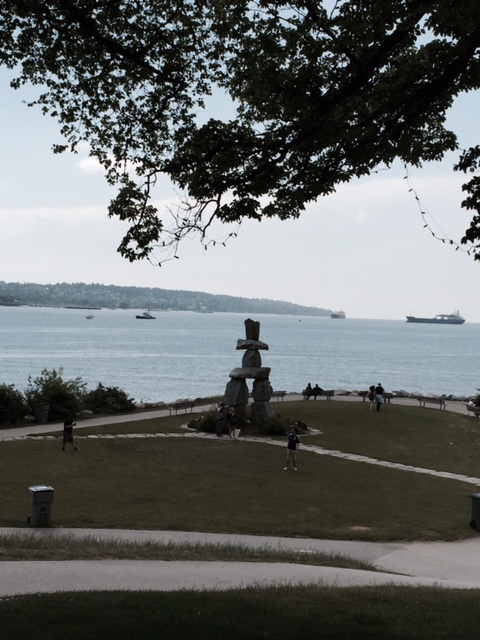
    This afternoon I went for a bike ride along Vancouver’s sea wall … and that’s OK.FullSizeRender


  • Cues and context

    At the conference last month in Texas, my cue was the name. If someone called me Becky, I knew that they had read at least part of this blog – if they called me Rebecca they knew me in a more professional context. Calling me Becky signalled that the person knew at least part of my story. They had context. I thought I blogged about how the name was a signal for me – but I cannot seem to find it on either blog, so I may not have actually written it.

    Over last weekend in Ottawa, I attended part of the Canadian Unitarian Council’s Annual Conference and Meeting. Many people there knew my story. Since I go by Becky with my church friends, the name was not a signal. Instead the signal was my hair. If someone said, “wow you have lots of hair” usually following by a deep heartfelt hug, then I knew they knew my story. A funny aside, someone commented that it was no longer socially acceptable to rub my head, which made me giggle. If they said “you cut your hair” then it was clear that they did not know. This happened a few times. At least once, when someone asked me how things were going in California, I said that “I had some health issues”. I told others “I had breast cancer”. I found myself playing with different ways of approaching the topic, but for the most part, I just accepted heartfelt hugs and smiled. I certainly did not go under hugged on this trip.

    One of the biggest challenges for me on this trip is the sense that I people are “happy to see me well” and “glad to see that I’m strong”. The problem is that I don’t feel that well or that strong. I found that I was surrounding myself with visits, but at the same time I exhausted myself. I had to remind myself that I’m still recovering, that I’m not there yet. It doesn’t help that my neuropathy in my feet is acting up, as is some tendonitis in my shoulder. So my body is providing a constant reminder to me that I need to take more time to heal. I need to rebuild my strength. It isn’t something that comes back overnight – just because treatment is over, doesn’t mean that I’m magically better, magically stronger. These things take time, and I need to remember to give myself that time.

    I’ve been gone for a week, and as Spirit of the West is apt to say, “I need home for a rest, take me home…


  • Where do I go from here?

    Yesterday and the day before were filled with emotions, hugs, and visits with so many people.

    One of the things that happened yesterday was a meeting with my PhD thesis committee and the director of the PhD program. I presented a quick overview of my project (from my proposal seminar) and an update on the data that I had. I was disappointed that one of my committee members didn’t attend. The meeting was setup over a month ago, so I feel a little disrespected.

    After much discussion, the conclusion of my committee and the program director was that I do not have enough data to write a dissertation. The path forward at uOttawa has two options:

    Option 1 involves a change of methodology – from Educational design research to Case Study – and would require doing another round of interviews, which would require ethics approval from two ethics boards. It would involve a lot of reading on this new methodology, and preparation of new interviews / surveys to align with the new methodology.

    Option 2 involves a new project. I would not need to do comprehensive exams or a formal proposal seminar as I have already met those requirements; however, I would need to write some form of proposal that my committee agreed to. In addition, I’d need to change supervisors (my supervisor is retiring) and form a committee that better aligns with the new project.

    An additional option would be that I transfer universities. That, however, would involve having to re-do comprehensive exams and the equivalent of a proposal seminar as well as additional coursework. Changing universities would be a three year commitment and would be expensive (since I’m on full scholarship at uOttawa).

    My issue now is to figure how I want to be spending my time. I was ready to commit to writing a dissertation based upon the data I had. I figured that if I focused on it for eight month, I could finish before my scholarship ran out. However, that is not an option.

    My challenge now is to figure out what I want to do? How do I want to be spending my time? I may very well look at taking a second year of medical leave, giving myself more time to figure out where I want to go. A second year of medical leave would mean that option 1 is dead, and option 2 is the path that I would be taking. It would give me some more time to explore where I want to go, and to self-study new methodologies, so that when I do go back I can “hit the ground running” so to speak.

    One thing that has changed over the last year is what I value in research – my axiology. I began my PhD journey as a very pragmatic researcher. I am now much more interested in participatory research. I am intrigued by autoethnography and collaborative ethnography. I value innovation – that is something that has not changed. It is, however, something that is not seen as research at uOttawa.

    I also do not want a plan forward that requires that I fly to Ottawa on a regular basis (once / semester is OK, but once/month is asking a lot). I enjoy my visits to Ottawa, but the travel takes a lot of energy. It is expensive from both a financial and physical health perspective. In changing supervisors, I would need to have a supervisor that is willing to supervise remotely. uOttawa isn’t the best place for remote supervision. It has been suggested several times that I look into transferring to a school close by where I live. For me, the location of the school shouldn’t matter. I should be able to do my research from anywhere in the world. There is a philosophical distance that may be harder to surmount than the physical distance.

    An so, part of the reason for the meeting yesterday was to help determine what my options were for paths forward. Although the path that I wanted (I guess I didn’t even realize I wanted it) is not a valid path, at least I now have some clarity on that. I know better what my options are, I just need to decide what I want to do about it.

  • A picture is worth 1000 words

    A picture is worth 1000 words … or so they say.

    I recently participated in an interview for an academic study on care and vulnerability among academics. When asked about where I draw the line with what I share, two things came to mind. First was in areas around sexuality, and second was with pictures of my breasts. I’ve struggled with both, in part because I think there are things that need to be said, and would be valuable for others going through breast cancer to hear – but there are still limits to what even I am willing to share publicly on the internet.

    That being said, a friend is about to go through the same kind of reconstruction surgery that I went through. When we talked about it, I was able to show her some photos that were on my phone. These were a great help to her. She was comforted by my success stories, as most of what she had seen were the horror stories.

    When I was at the ed tech conference in Texas a couple weeks ago, there were a few people that I showed pictures to. Again, this was in part to help them better understand what was involved. It was a sharing that helped to deepen our relationship.

    I have struggled with how I could share pictures in a way that was not so public as this site, but would allow me to still share them with people who want to see them. I thought about putting them into an ebook behind a paywall – so only those who paid for them would see them, but that didn’t really seem to address my concern. Part of it is, I want to know who has seen them. Even if the person is a complete stranger, I still want to know who they are. It is because the sharing of such pictures is sharing an intimacy (note that the pictures do not involve face or groin (except one or two) – that is intentional. They show the scars and the wounds in a more objective manner. They help the viewer better appreciate what the surgeries entailed. They help the viewers better prepare (or empathize). But they also serve to deepen the relationship between me and the person viewing the images.

    With that said, if you are reading my blog for whatever reason, and you do want to see the pictures of my wounds (photos taken almost daily from my first surgery through to mostly healing of my scars), then please email me (rhogue@pobox.com). I will not post a link here. I will not post the password here. I will, however, share with those who read this blog and want to know me on a deeper level – or who want to better understand the outcomes of the surgery that I had. Just send me a note to let me know a little something about you, so that I know I’m not sharing my photos with someone who will publicly display them or exploit them in any way. Because, sometimes a picture (or in this case a series of pictures) is worth more than 1000 words.

  • Today I miss my nipples

    When you are finished with the acute treatment for breast cancer, the doctors talk about the difficult time you will have. They talk about how it is related to all the attention you get from your care providers during the acute treatment stage. Then suddenly, you are set free and feel somewhat abandoned. I definitely felt that way. However, I think that was the easy part. I found other healthcare providers to help keep me on track – I was never really left without them – I just see different people now. So instead of weekly visits with the infusion nurses, I have weekly visits with a physiotherapist.

    So, although abandonment is part of what creates the down/depressions after acute treatment, that is only a small part of it. Our healthcare providers are missing something big here – in that they are looking at the problem from a healthcare provider centric view and not from a patient point of view. From their view, they see patients feeling abandoned. They don’t seen the internal struggles that patients are facing.

    Early in my cancer journey, I wrote asking How does one prepare to lose a body part? In truth, you prepare by trying to be strong when you go into surgery, but also giving yourself permission not to be. Since I did chemotherapy first, I had a lot of time to prepare myself for the surgery. By the time surgery came, it wasn’t scary anymore. I knew what to expect. I had done my research. I was OK with it all.

    What I couldn’t prepare for was the sense of loss that comes with losing a body part. It doesn’t come right away. During acute treatment you are focused on getting done what needs to be done and staying alive. After that, you become focused on regaining your strength, and on letting the physical wounds heal. It isn’t until you start to reclaim portions of your old life that the loss really starts to sink in. It is then that you really start to internalize what has changed.

    So for me, today, I miss my nipples. I had a nipple sparing bilateral mastectomy with immediate DIEP flap reconstruction. That means, that I actually have my nipples. When I look in the mirror, they look like my nipples (mostly – they are scared and have faded and flattened). But they are also dead nipples. My reconstructed breasts have no sensation. My nipples no longer react to stimulation – they are dead inside – they only exist for cosmetic purposes. Don’t get me wrong, I’m thankful to have them – and to be able to look in the mirror and see my nipples and not some empty stomach tissue or some reconstruction of a nipple – but I am sad at the loss of sensation. I miss it. And it is this type of loss that doesn’t really sink in until you start reclaiming your old life. Until things start to get back to normal, and then you discover some little (or not so little) thing that cancer has taken away from you. And that is what makes survivorship so hard. It isn’t the abandonment from your doctors, it is those times when you realize just how much you have lost.

  • Auspicious dates and my diagnosis story

    I have a lot of anniversaries coming up … so I’m expecting that my life will be filled with emotion.

    In preparing this post, I realized that I never really wrote out my diagnosis story. I spoke it many times at support groups, but never actually wrote it out in this blog.

    It all began with the feeling of a hard spot under my left breast (June 1st). Since my stuff had arrived from Canada earlier that week, we had been unpacking. After a few days of unpacking, we decided to take Sunday afternoon off and go for a bike ride. I actually wrote a bit about the bike ride and shared some pictures when I talked about my cancerversary –http://bcbecky.com/2014/08/my-cancerversary/. I had no idea then how I would be feeling now!

    Each day, as I got out of the shower, and before I went to sleep at night, I kept checking my left breast, in hopes that the hard spot would be gone. It wasn’t. After a week – on Monday June 9th, as 8:30 in the morning I called my primary care’s office to see if I could get in and get it checked out. They had a spot open at 9:20am. I remember walking in all cavalier, and says “this is probably nothing” and “maybe I’m overreacting” but for “peace of mind” I wanted to get it check out. She did a breast exam and confirmed that I was feeling something. I could tell there was definitely some concern in her eyes. She put in a referral for diagnostic (not screening) mammogram and ultrasound. The way she explained it and the way it happened were different.

    I proceeded to go downstairs and book an appointment. The soonest they could get me in was Thursday afternoon. I went home, and jumped on my recumbent bike and went for a long bike ride. I ended up out at Scott’s office, and we rode home together. I remember upon arriving at his office that some of his coworkers were there. They wanted to try out my bike, so we did a little bit of that, before heading home. As we left the Alcatel parking lot, I told Scott that I had found a lump in my breast and that I had an appointment on Thursday to have it looked at.

    Originally, he was not going to be with me at the Thursday appointment – however, I read the information page they gave me, and at the bottom it said “You will get your results immediately”. With that, I decided that it would be better if he did come along (thank goodness!).

    The diagnostics began with a mammogram – which was horribly painful given the large lump in my breast! Then an ultrasound. The tech said – this is what you were feeling?  Uh- yah!

    After the ultrasound, they said I could get dressed and that the radiologist would like to speak to me. I mentioned that my husband was with me in the waiting room and could he please come to the discussion with the radiologist. They had no problem with that, showed us to an office, and the radiologist came in. He was pretty up front. He said – It is cancer. He had called upstairs to the surgeons office, and in 45-minutes the surgeon could seem me to do a biopsy. He commented that if his mother or wife had cancer, this is the surgeon he would recommend. At the time, I did not understand that the surgeon is the first doctor you see when you are diagnosed with breast cancer. I was surprised I wasn’t being referred to an oncologist.

    After a short walk around the PAFM Mountain View clinic, we went up to the surgeons office. The surgeon was pretty matter of fact about doing the biopsy. He said to book an appointment for the following week (when the pathology results would be known). Because of my age, he also recommended genetic counseling, so we booked that appointment too. He gave us the quick 5-minute version of the longer 45-minute talk that would happen the following week. The short comment was that I likely needed a mastectomy. While we were doing the biopsy and talking with the surgeon, the radiologist called. They wanted to see me back downstairs at the mammogram / ultrasound lab because the radiologist saw something suspicious in my other breast. So, downstairs we went, off with my top again, and he validated that it could be seen on the ultrasound. We booked an ultrasound-guided biopsy for the next day (Friday). I also had a chest x-ray and a bunch of blood work done.

    On Friday we met with the genetic councilor. We drew blood for that, but couldn’t submit the panel until we had confirmed pathology – at which time the insurance would cover the test. I did the guided ultrasound guided biopsy on Friday afternoon.

    As I was supposed to by flying to Ottawa on Saturday, I had to cancel my travel plans and inform a few people of what was happening. Because we didn’t have pathology, we didn’t want to make things public just yet. It was all very awkward.

    On the weekend, we went for a walk around Sausalito. I recall that walk because I found myself checking out women’s breasts. It was and odd thing really.

    On Monday, I received two phone calls from my surgeon confirming breast cancer in both breasts.

    On Friday, we went up to Stanford for a second opinion. After appointments, I did my first breast MRI. It was the breast MRI that showed the third tumor.

    So, there is my diagnosis story … details of how thing unfolded starting on the weekend after diagnosis are described in detail on the blog. I just seem to have missed the very start of the story.


  • Doing well – mentally

    I haven’t been writing as much on this blog lately. In part, that is because I’ve been feeling well, and in part because I’ve had this particular post in my head for a few days but I wanted to wait until after this weeks doctors appointments before writing it. I was reflecting today on how I don’t do a good job of writing about things when they are going well. It is so much easier to find things to say when you are struggling, but as things start to get back to normal and go well, I wonder what I should be talking about?

    Something really clicked for me a few weeks ago. It was almost like a huge weight was lifted off my shoulders. I’ve been doing some cognitive behavior therapy that has really helped. I’ve learned to internalize the idea that I can change the way I feel by changing the way I think. More to the point, that once I recognize that my thinking is going down a negative path, I can re-program my brain to stop doing that. What has been cool about this, is that it has not only reduced my stress about cancer recurrence, it has also helped me cope with impostor syndrome when I’m in an academic setting. I’m finding ways to use the cognitive behavior therapy in areas of my life that go well beyond breast cancer treatment.

    Part of dealing with the fear of recurrence is that I needed to develop a deeper understanding of what I fear the most – metastatic disease. More to that point, I needed to understand what a metastatic diagnosis might mean to me.  How would it change my life? At some point, I realized that other than logistics issues, it wouldn’t. I would still want to be doing the things I’m doing. I’d still want to go to academic conferences and write academic papers and collaborate with some really cool people. Heck, at the conference last week I actually had fun!

    I also realized that the worry about recurrence was not serving a positive purpose. Before my diagnosis, the worry that I had about breast cancer was minimal – however, I still checked my breasts every time I got in the shower. It was part of my normal routine – soap up and examine for changes. It was during that time that I discovered the hard area, and then the change in discharge. So, it was a week later than I saw myself in my primary care doctors office, and later that week the radiologist told me I had cancer. My point is, that I had only a low level of worry, and that low level was enough for me to be diligent and to find the cancer quickly. Adding more worry would not have changed my outcome. So, that same logic is sinking in regarding recurrence. At first, I thought every pain was a recurrence. I was constantly worried about it. Now, that worry has lifted. I’ve managed to replace it with the idea that I’m going to go ahead and live my life, cancer be damned!

    It has been freeing to let go of the worry. I’ve gone back to some of my contract work, and I’m making progress on it. I have a to do list a mile long, but I’m making slow progress on it. I’m also regularly asking myself is this what I want to be doing with my time? Is this how I want to be living my life?

    Now don’t get me wrong, I’m still struggling physically. I’m still wanting to be doing more things than my body will currently allow. But I’m also having fun collaborating with people from around the world. Next week I’ll be in Ottawa visiting so many of my friends that I have missed this last year. I’m doing exactly what I want to be doing, and that is a blessing.

  • Empathy Cards

    These new empathy cards by Emily McDowell have crossed my social media stream several times in the last few days –http://emilymcdowell.com/collections/cards/Empathy-Cards.

    I think they are the most awesome cards to send to someone who is experiencing cancer, so I thought I’d share the link here. As a cancer survivor, she really does a great job of giving people in our lives some tools to say things when they really don’t know what or how to say them … take a look, it’s OK to giggle, but I also encourage you to really think about why these cards resonate so much with people going through cancer treatment.

  • Being in the present

    This weekend we are camping at Pfeiffer Big Sur State Park. I made the reservations months ago, only able to guess as to whether or not I’d be well enough to camp. Our camping spot is beautiful but I must say that Big Basin has spoiled us. We are in a grove of redwoods and although they are giant ancient trees they are not as giant or ancient as Big Basin. The park itself is actually named after the Big Sur River which flows though the park and is just across the street from our campground. The Coastal Mountains here are bigger than the Santa Cruz range up by where we live, so the river gets more water from the coastal fog. Things here are still pretty green and moist, were things at home have started to dry up.

    After a night of camping I’m doing pretty good. My biggest physical challenge is sitting up from my sleeping bag. Since I’m on the ground the roll out of bed technique doesn’t work.  When I do yoga on the floor at home, I hook my arms under my thigh and use my butt as a pivot point and gravity to swing up into a seated position.  That doesn’t work too well when your legs are in a sleeping bag.  Instead, I am forced to use my very weak abdominal muscles to get up. In the end, this is probably a good thing as it helps to strengthen them. It is just one more physical effort for the day that I didn’t expect.

    After my late night trip to the loo, I spotted something moving along the trail back to our campsite. Fortunately, I have a good headlap, so I did a quick search out of the area. Rather than what I expected (racoons), it was a skunk. There was no smell to warn of its presence here. I choose to walk the long way back to the tent!


    After a second night in the tent I’m exhausted and my back aches. The physical effort to turn from one side to the other while in a sleeping bag is non-trivial. Again, this means that sleep means exercise. I awoke this morning to a grey sky, which echoes kind of how I’m feeling. The cloud bank is about 100 feet up, so things are not damp on the ground (yay).

    The birds are chirping and squawking, and the river is still flowing – which means the sounds I hear are mostly of nature with the occasional child crying as they wake in their tents. Taking deep breaths helps to remind me of where I am and to be in the present. It is beautiful here – and smells of nature (old trees and moss). Now that I am up and moving around a bit my back ache subsides. Mental note for next time, I need to remember to stretch before climbing into the tent.

    I am briefly visited by a blue jay type bird – not a blue jay. Up at Big Basin they are considered pests. They are not timid and will eat right off your table. There they also eat the eggs of another endangered bird that nests in the area. There is no mention of “crumb clean” camping here, and just like us, the birds are welcome visitors to the campground.

    Our plan is to spend two weeks in June mostly camping in Northern California. If I’m not stronger by then, I foresee a couple of nights in either tent cabins or hotels just to give my core a break.  I never thought camping was so much physical work!

css.php